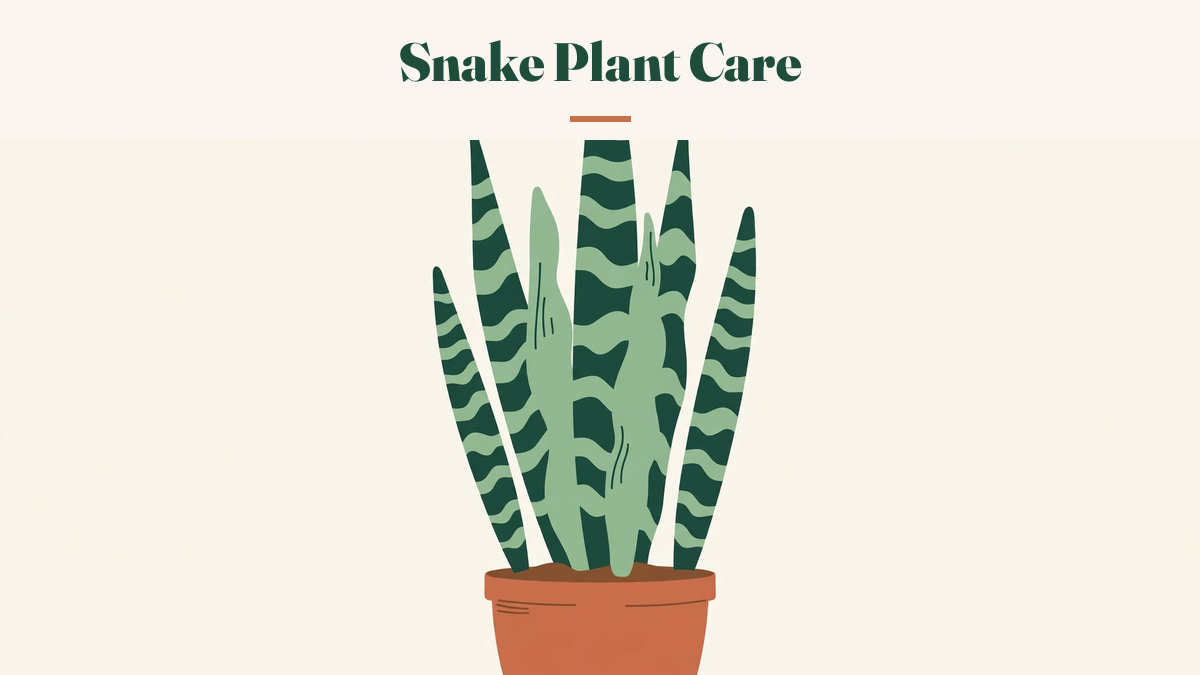
The first snake plant I killed died of kindness. It was a handsome 'Laurentii' in a deep ceramic pot, and I watered it every Sunday along with everything else on the shelf — same jug, same routine, same good intentions. For three months it looked perfect. Then one leaf went soft at the base and slid out of the soil when I touched it, smelling faintly of rot. Within two weeks, the whole plant had collapsed into a mushy heap. I had watered it to death while believing I was being a responsible plant owner.
That is the snake plant's (Sansevieria trifasciata, also sold as Dracaena trifasciata — nurseries use both names for the same plant) one great irony: it is the easiest houseplant to keep alive, and the easiest to kill by caring for it like a normal plant. It is built to survive months without water. Give it a weekly drink and its roots rot. The plant I have now gets watered about once a month, lives in a pot that looks too small for it, and has never once looked unhappy. This guide is mostly about resisting the urge to do more.
The rhizome: why it barely needs water
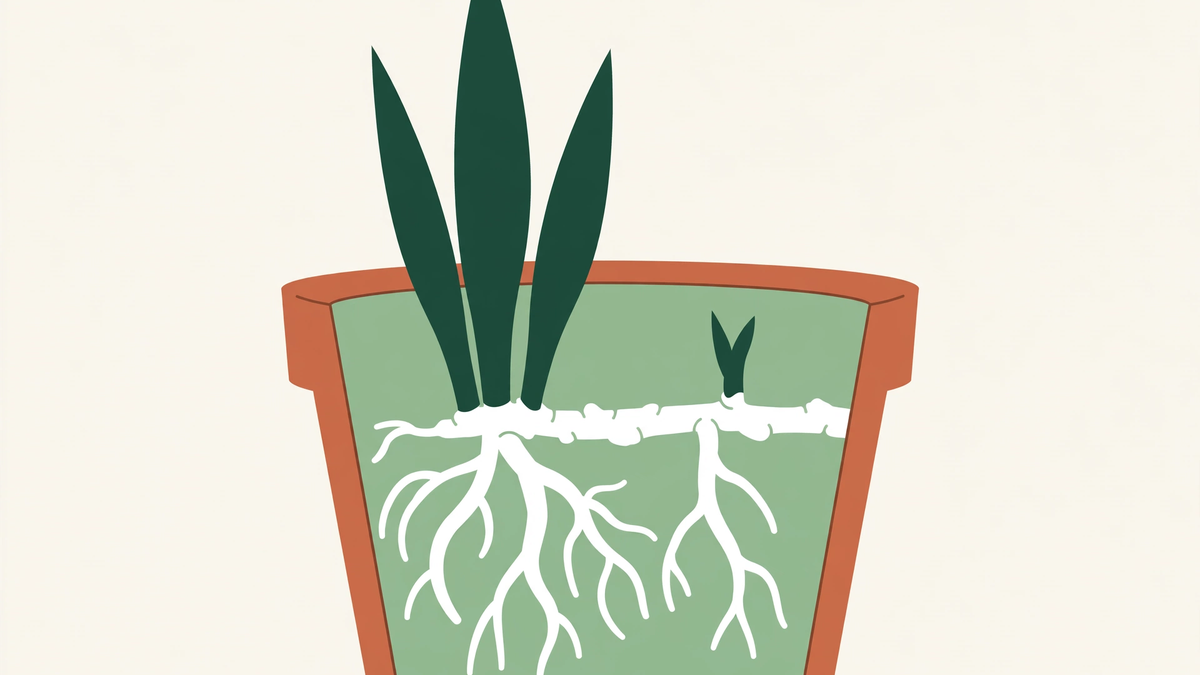
Everything about snake plant care makes sense once you know what is going on underground. Below the soil, a snake plant has thick, fleshy rhizomes — horizontal underground stems that store water like a camel stores fat. New leaves sprout from these rhizomes, and the rhizomes themselves can keep the plant going for weeks or months without a single drop of water.
This is an adaptation to its native habitat in the dry, rocky parts of tropical Africa, where it grows in thin soil and goes long periods between rains. The plant is built for drought, not for damp. Its leaves are also thick and waxy, which slows water loss, and its stomata — the tiny pores leaves breathe through — open at night rather than during the heat of the day, which conserves even more moisture.
The practical consequence is simple: a snake plant's water tank is already full most of the time. When you water on a normal houseplant schedule, you are topping up a tank that does not need it, and the excess sits around the rhizomes and rots them. Rot is the one thing a snake plant cannot recover from easily. A dry snake plant revives within days of a good watering. A rotted one often cannot be saved.
So the first rule of snake plant care is not a schedule — it is a test. Water only when the soil is completely dry all the way through the pot, not just at the surface. Push a finger or a wooden skewer down to the bottom of the pot. If there is any dampness at all, wait. If the soil is dry and the pot feels light, water thoroughly until it drains, then leave it alone again.
A seasonal watering table
Because "water when dry" can feel vague when you are starting out, here is the rhythm I actually use, based on a snake plant in a 15–20 cm pot in a typical indoor room. Treat these as starting points, not rules — always check the soil first.
| Season | How often I water | What the plant is doing |
|---|---|---|
| Spring (Mar–May) | Every 2–3 weeks | Waking up; new leaves start appearing |
| Summer (Jun–Aug) | Every 2 weeks | Growing fastest; warm rooms dry the soil sooner |
| Autumn (Sep–Nov) | Every 3–4 weeks | Slowing down as light fades |
| Winter (Dec–Feb) | Every 4–6 weeks, sometimes less | Nearly dormant; the soil barely dries at all |
Two things can shift these numbers a lot. The first is the pot: terracotta dries out much faster than plastic or glazed ceramic, so a terracotta-potted snake plant may need water a week sooner. The second is light: a plant in a bright, warm spot drinks faster than one in a dim corner. A snake plant in a dark hallway in winter might genuinely not need water for two months, and that is fine.
If you remember one number, make it this: in an average home, a snake plant needs water roughly half as often as most of your other houseplants. If you water everything else weekly, water this one fortnightly at most. If you are ever unsure, wait another week. Snake plants forgive drought far more easily than they forgive a wet pot.
Light: tolerates low, prefers bright
Snake plants are famous for surviving in dark corners, and it is true — they will live for months in a room with almost no natural light. But surviving and growing are different things, and the difference shows in the leaves.
In low light, a snake plant grows very slowly, its new leaves come up thinner and more flexible, and the yellow edges on variegated varieties like 'Laurentii' fade or disappear on new growth. The plant is not dying; it is just idling. In bright indirect light, the same plant pushes out thick, stiff, upright leaves with strong variegation, and it grows noticeably faster in spring and summer.
The sweet spot is bright indirect light — near a window but out of the harshest midday sun. A few hours of gentle morning or late-afternoon sun is fine, and a snake plant that has been gradually introduced to it can even handle a sunny windowsill. Just do not move a plant that has lived in a dark corner straight into full sun: the leaves will scorch. Acclimatise it over a couple of weeks, moving it a little closer to the light every few days.
If low light is all you have, the snake plant is still one of your best options — it is on my list of the best low-light indoor plants for exactly this reason. Just set your expectations: slow growth, plain green new leaves, and very infrequent watering.
Soil, pots, and the shallow-root surprise
Snake plants have surprisingly shallow roots for such tall leaves. The rhizomes spread sideways just below the surface rather than diving deep, which has two practical consequences.
First, the pot should be wide rather than deep. A tall, narrow pot holds a column of damp soil below the roots that never dries out — exactly the conditions that cause rot. A wide, shallow pot matches the root shape and dries more evenly. Second, the soil must drain fast. I use ordinary houseplant mix with about a third perlite or coarse sand mixed in, or a cactus and succulent mix straight from the bag. Either way, water should run through quickly when you water, not sit on the surface.
Drainage holes are non-negotiable for snake plants. A pot without them is the fastest route to rot, because there is no escape for excess water. If you have fallen in love with a beautiful pot that has no holes, use it as a cover pot: keep the plant in a plain nursery pot with holes inside it, and always empty the cover pot after watering.
Snake plants also like being slightly snug. They grow happily in a pot that looks a bit small for them, and a mature plant sometimes surprises you with a spike of small, sweet-scented white blooms in summer — the RHS notes the flowers are occasionally fragrant. Repot only when the rhizomes are pushing against the pot walls or cracking a terracotta pot, which can take two to three years. When you do repot, go up just one size, and do it in spring.
When the leaves lean: the two causes
The most common snake plant complaint after rot is leaves that lean, flop, or fall over. It looks alarming, but the cause is usually one of two things.
Overwatering at the base. If a leaf is soft, mushy, or translucent at the base where it meets the soil, the rhizome underneath has rotted. Pull the leaf gently — if it slides out with a wet, soft base, that leaf is gone. Check the rest of the plant: if only one or two leaves are affected and the remaining rhizome is firm, remove the rotten parts, let the soil dry out completely, and the plant can recover. If the whole base is soft, the best move is to take healthy leaf cuttings and start again. The full rescue process is in my guide on how to fix root rot.
Too little light. Leaves grown in dim conditions are thinner and weaker, and tall leaves eventually cannot hold themselves upright. The fix is more light and patience: the floppy leaves will not stiffen up again, but new leaves grown in brighter conditions will be thick and upright. You can stake a leaning leaf loosely to a neighbour for support, or simply remove it if it bothers you — the plant will replace it.
A third, rarer cause is a plant that has grown so tall and top-heavy that the pot tips. Snake plants in tall, narrow pots can become unstable. The fix is a wider, heavier pot — terracotta is ideal — rather than a deeper one.
Dividing and propagating: free plants from one pot
A healthy snake plant eventually fills its pot with rhizomes and new leaves, and that is your cue to divide it. Spring is the best time. Slide the plant out of its pot, shake off the loose soil, and look for the rhizomes connecting the leaf clusters. A clean, sharp knife cuts through them easily. Each division needs at least a few leaves and a section of rhizome with roots attached.
Pot each division into its own pot with fresh, gritty mix, water lightly, and leave it alone. Divisions usually settle in within a few weeks and start pushing new growth by midsummer. One crowded snake plant can easily become three — the step-by-step, with photos of where to cut, is in my guide on how to divide a snake plant.
You can also propagate from leaf cuttings: cut a leaf into 8–10 cm pieces, let the cut ends dry for a day, then stand them in soil or water. They root slowly — expect two to three months before new growth appears — and one thing to know: leaf cuttings of variegated varieties like 'Laurentii' grow back plain green. Only division preserves the yellow edges.
Terracotta vs plastic: what I noticed
After losing that first plant to rot, I repotted its replacement into terracotta and kept a second snake plant in its plastic nursery pot, and the difference taught me more than any care guide. The terracotta pot dried out a full week sooner than the plastic one in the same room, and the soil in it never stayed damp at the bottom. The plant in plastic needed me to check the soil with a skewer every time, because the surface could look dry while the bottom was still wet — the exact trap that had killed the first plant.
That is why I now grow all my snake plants in terracotta. It is not that plastic cannot work — it can, if you are disciplined about checking the soil all the way down. But terracotta forgives a heavy hand in a way plastic does not, because the pot itself breathes and pulls moisture out of the soil. For a plant whose main risk is too much water, that margin matters. If you love a glazed or ceramic pot, use it as a cover pot and keep the plant in terracotta inside it.
The feeding question (and why less is more)
Snake plants need very little food. In spring and summer, a half-strength balanced liquid feed once every six to eight weeks is more than enough. I have gone entire years without feeding a snake plant and it grew perfectly well. Overfeeding causes more problems than underfeeding: fertiliser salts build up in the dry soil and burn the leaf tips, and a plant pushed into soft, fast growth is more prone to flopping.
If you feed, water first, then feed — never pour fertiliser onto bone-dry soil, as it can scorch the roots. And skip feeding entirely from autumn through winter. The plant is barely growing, and the food just sits in the soil.
Choosing a snake plant: the varieties worth knowing
Not all snake plants look alike, and the variety you pick changes how the plant fits your space. The care is the same for all of them — the differences are size, shape, and colour.
Sansevieria trifasciata 'Laurentii' is the classic: tall, sword-like leaves up to a metre high, dark green with lighter mottling and a bold yellow edge. It is the one you see everywhere, and it is the best choice if you want a statement plant for a floor pot. It also shows you quickly whether the light is good enough — new leaves come out with strong yellow edges in bright light and plain green in dim light.
'Moonshine' is the softer cousin: wide, silvery-green leaves with a pale, almost frosted look. It grows a little shorter than 'Laurentii' and suits a shelf or side table better than a floor. The pale leaves show dust more, so a wipe with a damp cloth every few weeks keeps it looking its best.
Sansevieria cylindrica breaks the mould entirely: its leaves are round, spear-like tubes that grow straight up, sometimes braided together by the nursery. It is the most sculptural of the group and the most tolerant of a sunny windowsill. It grows slowly, so buy the size you want rather than hoping it will catch up quickly.
'Hahnii', the bird's nest snake plant, is the small one: a compact rosette of short, wide leaves that stays under 20 cm tall. It is the best snake plant for a desk or a narrow windowsill, and it is the one I recommend when someone wants the easy care without the floor-space commitment.
Whichever you choose, check the base before you buy. The leaves should feel firm and upright right down to the soil, with no softness, no yellowing at the base, and no musty smell from the pot. A plant that is already rotting at the shop will not recover, however good your care is.
Frequently asked questions
How often should I water a snake plant?
Every 2–6 weeks depending on the season — only when the soil is completely dry all the way through. In winter, once a month or less is plenty.
Why are my snake plant leaves falling over?
Usually overwatering has rotted the base, or the plant is in too little light and the leaves have grown weak and floppy. Check the base of the leaves for softness.
Can a snake plant live in a dark room?
It will survive in low light for a long time, but it barely grows there. Bright indirect light keeps the leaves upright and the variegation strong.
Why is my snake plant not growing?
Snake plants grow slowly, especially in low light or winter. If it has been still for a whole growing season, move it to brighter light and check it is not root-bound.
Is a snake plant safe for pets?
No — snake plants are mildly toxic to cats and dogs if chewed. Keep them out of reach. Pet-safe lists are guidance — check with a vet for your animal.
If you remember one thing… a snake plant's rhizomes are already full of water, so the kindest thing you can do is leave the watering can alone until the soil is dry all the way through.