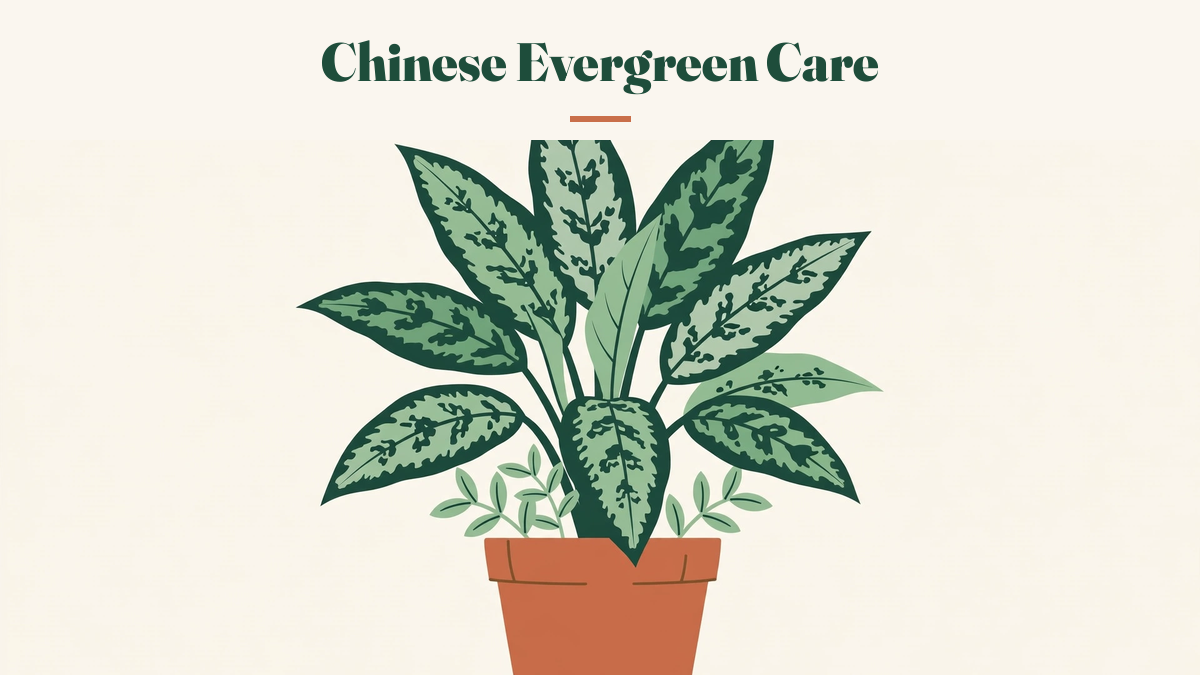
I nearly killed my chinese evergreen with a window. It was January, the room felt stuffy, and I opened the window for ten minutes of fresh air — with the plant sitting on the sill beside it. By the next morning, three leaves had developed dark, water-soaked patches that never recovered. Ten minutes of cold air did what months of dim light and irregular watering never had. That is the thing nobody tells you about chinese evergreen: it is famously tough about light, water, and neglect, and famously fragile about cold. Get the temperature right and it is one of the easiest plants you will ever own. Get it wrong and it falls apart fast.
Chinese evergreen — Aglaonema — is the plant I recommend to anyone with a dark room and a history of killing things. It is, in the words of the NC State Extension service, one of the easiest plants to grow in the home or office. It tolerates low light that would starve a pothos, shrugs off dry air, and keeps its patterned leaves looking good with minimal attention. But it has two genuine weaknesses — cold and wet soil — and this guide is built around both of them.
The low-light claim, honestly tested
Every plant label says chinese evergreen tolerates low light. I wanted to know how true that was, so I ran an unplanned experiment: two plants of the same cultivar ('Maria', the silver-patterned green type), one in a bright east-facing room and one in a north-facing hallway that gets no direct sun at all, kept there for eight weeks over one summer with the same watering routine.
| Bright room (east window) | Dim hallway (north-facing) | |
|---|---|---|
| New leaves in 8 weeks | 5 | 2 |
| Leaf colour | Strong silver pattern | Pattern held, slightly duller |
| Stem growth | Upright, compact | Slight lean toward the light |
| Overall health | Excellent | Good — slower, but healthy |
The dim plant grew at less than half the pace, but it did not drop leaves, stretch badly, or look unhappy — it just ticked along slowly. That is the honest version of "tolerates low light": it survives and stays attractive, but it grows slowly. A chinese evergreen in a dark corner is a plant in maintenance mode, not growth mode, and that is fine as long as you know it.
How dim is too dim? My rule of thumb: if you can read a book in the spot during the day without switching a light on, a green chinese evergreen will manage there. If you need a lamp to read, it is too dark even for this plant — no houseplant grows in the dark, whatever the label promises. A north-facing window, a hallway with a borrowed light, or a spot a few metres back from a bright window all pass the test. A windowless bathroom or a cupboard does not.
One important qualifier: cultivar matters. Solid green types like 'Maria' and 'Silver Bay' tolerate the lowest light. Variegated and red types — 'Siam Aurora', 'Crete', the pink ones — need noticeably more light to hold their colour, because their coloured tissue has less chlorophyll to work with. A red aglaonema in a dark hallway will slowly fade to green. If your room is genuinely dim, buy green.
Direct sun is the one light condition chinese evergreen does not tolerate. The RHS is clear that direct sun may scorch the foliage, and I have seen it happen: pale, bleached patches on leaves that sat in a south-facing window through a sunny afternoon. Bright, filtered light is the sweet spot — an east window, a north window, or a few feet back from a south or west window. If you are working out what your windows actually offer, my guide to the best low-light houseplants ranks plants by how dim a spot they genuinely accept.
Cold is the real enemy
Chinese evergreen comes from the tropical and subtropical forests of Southeast Asia and New Guinea, and it has no tolerance for cold whatsoever. NC State notes it is intolerant of cold temperatures and prefers daytime temperatures of 21–27°C. Clemson University's guidance puts the floor at about 13°C, with chilling injury possible below 10°C.
In practice, that means:
- Keep it away from windows in winter. A windowsill that feels cold to your hand is too cold for this plant. Leaves touching cold glass will develop dark patches within hours.
- Watch for draughts. The front door, a frequently opened window, an air-conditioning vent blowing directly on the plant — all of them can cause cold damage. My January window incident was a draught, not a freeze, and it still marked three leaves.
- Do not move it outdoors in spring until nights are reliably warm. A single cold night below 10°C can damage it. I wait until nighttime temperatures are consistently above 13°C, and even then I bring it in if a cold snap is forecast.
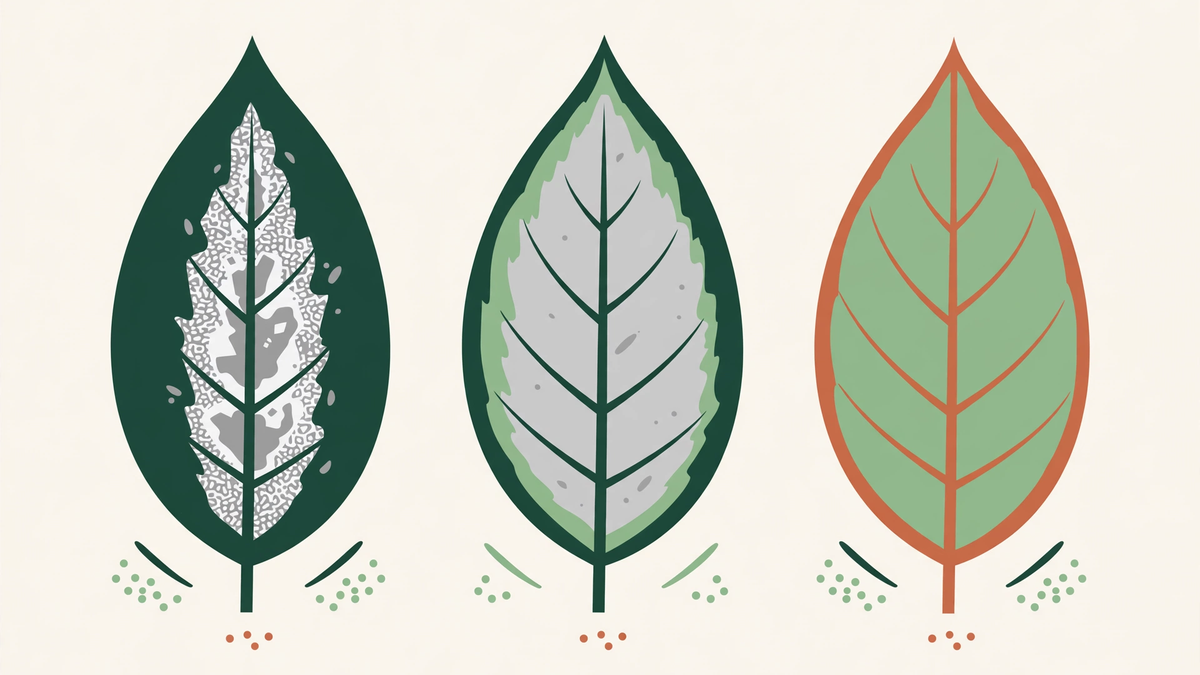
- Cold damage looks like dark, water-soaked patches that turn brown and papery. The damaged leaves will not recover — trim them off and move the plant somewhere warmer. The plant itself usually recovers fine if the stem and roots were not chilled.
This is also why chinese evergreen is such a good office plant: offices are warm, stable, and draught-free, which is exactly what it wants. Mine has spent years in a warm hallway with no direct sun and no drama, and it is one of the most reliable plants I own. If you are choosing plants for a desk, my guide to the best office desk plants has more warm-room survivors.
Watering: moist, never soggy
Chinese evergreen wants its soil evenly moist — not wet, not dry. The practical test is the top 2–5 cm of soil: when it feels dry, water; when it still feels damp, wait. In my flat that works out to roughly every one to three weeks, depending on the season and the pot. In winter, when growth slows and the plant uses less water, I let it dry a little more between waterings.
Overwatering is the most common way people kill this plant, and it is a quiet killer. The roots rot in soggy soil, the stem softens at the base, and by the time the leaves start yellowing the damage is advanced. If your chinese evergreen is yellowing from the bottom up and the soil feels wet, unpot it and check the roots — black, mushy roots need cutting away, and the plant needs fresh, dry mix and a pot with drainage holes.
Underwatering is more forgiving. The leaves droop and the edges crisp, but a thorough watering usually revives it within a day. That said, do not let it dry out completely on a regular basis — repeated drought stress shows up as brown leaf tips and stunted growth.
A few watering details that matter:
- Use room-temperature water. Cold water straight from the tap can shock the roots of a tropical plant. I fill the watering can the night before.
- Empty the saucer. Standing water is the fastest route to root rot, even for a plant that likes moisture.
- A plastic or glazed pot holds moisture better than terracotta, which dries fast. If your plant dries out too quickly in terracotta, switch the pot rather than watering more often.
The cultivars worth knowing
Garden centres sell dozens of aglaonema cultivars, and they are not interchangeable. The main differences are leaf pattern, colour, and how much light they need to hold it. These are the ones I have grown or seen grown well:
| Cultivar | Leaves | Light needs | Notes |
|---|---|---|---|
| 'Maria' | Dark green with silver centre | Lowest light of the group | The toughest and most forgiving; my first choice for dim rooms |
| 'Silver Bay' | Large silver-grey leaves, green edge | Low to medium | Bigger and bolder than 'Maria'; a real statement plant |
| 'Cutlass' | Narrow, pointed, silver-marbled | Low to medium | Upright and architectural; good for narrow spaces |
| 'Siam Aurora' | Green with red-pink edges and veins | Bright indirect | Needs more light to hold the red; fades in dim rooms |
| 'Crete' | Red and pink variegation | Bright indirect | Stunning colour, but the fussiest of the group about light |
| 'Modestum' (species) | Plain dark green, wavy margins | Low | The original species; unfussy and underrated |
If you are buying your first chinese evergreen, start with 'Maria' or 'Silver Bay'. They are the most forgiving, the most widely available, and the cheapest — and their silver patterning looks good in almost any room. Save the red types for a bright spot where they can show their colour.
Feeding, repotting, and dividing
Feeding is light. The RHS recommends a balanced liquid fertiliser monthly during the growing season, and that is plenty. Too much fertiliser shows up as brown leaf edges — Clemson specifically warns that excess fertiliser causes leaf-edge burn in aglaonema. I feed mine at half strength, once a month from spring to early autumn, and not at all in winter. A plant in low light needs even less, because it is growing slowly and cannot use the nutrients.
Repotting is a spring job, every two to three years, or when the roots fill the pot. Chinese evergreen is not a fast grower, so it does not need frequent repotting — and it tolerates being slightly root-bound better than sitting in a pot far too big for it. Go up one pot size, use a standard houseplant compost with a handful of perlite for drainage, and water it in well. My repotting guide walks through the whole process if you have never done it.
Repotting time is also the time to divide, and division is the easiest way to multiply a chinese evergreen. The plant grows in clumps, with new stems emerging from the base. To divide:
- Take the plant out of its pot and shake off most of the soil.
- Find a natural separation point between stems, each with its own roots.
- Pull or cut the clump apart gently — a clean knife helps for tough root balls.
- Pot each section separately in fresh mix, water well, and keep them warm and out of direct sun for a few weeks while they settle.
You can also propagate from stem cuttings: cut a stem section with a few leaves, let the cut end dry for a day, and root it in moist mix or water. Division is faster and more reliable, but cuttings are a good way to rescue a leggy plant — cut the bare stem, root the top, and let the stump sprout new growth.
Troubleshooting: what the leaves are telling you
Brown leaf tips. The most common complaint. Usually dry air, cold draughts, or too much fertiliser — sometimes all three in winter. Trim the brown tips with clean scissors (cut at an angle to follow the leaf's shape), ease off the feeding, and move the plant away from cold windows and radiators.
Yellow lower leaves. A few at a time is normal ageing. Several at once usually means overwatering — check the soil and the roots. If the soil is wet and the stem feels soft at the base, act fast: unpot, trim rotted roots, and repot in fresh mix.
Dark, water-soaked patches. Cold damage. Move the plant somewhere warm immediately and trim the damaged leaves. The plant will recover if the stem and roots are healthy.
Leggy stems with bare lower leaves. The plant is reaching for light, or it is simply old. Move it brighter, and consider cutting the leggy stem back in spring — the stump will usually sprout new growth, and the top can be rooted as a cutting.
Fading colour on red or pink cultivars. Not enough light. Move the plant to a brighter spot, gradually, over a week or two. The colour on existing leaves will not come back, but new leaves will show the full pattern.
Mealybugs. White, cottony clusters in the leaf joints. Dab them off with rubbing alcohol on a cotton bud, and check the plant weekly until they are gone. Aglaonema is not especially pest-prone, but mealybugs find it in dry indoor air.
Drooping leaves. Usually thirst — water thoroughly and the plant should perk up within a day. If the soil is wet and the plant still droops, the roots may be damaged. Check for rot.
Curling leaves. New leaves that emerge curled and stay curled usually mean the plant is too cold or too dry. Check the temperature first — a chinese evergreen near a cold window will curl its leaves before it shows any other symptom — then check the soil moisture.
Pet safety
Chinese evergreen is toxic to cats, dogs, and horses if eaten — the ASPCA lists it, and the toxic principle is insoluble calcium oxalate crystals, the same irritant found in pothos and philodendron. Chewing the leaves causes mouth pain, drooling, and vomiting. The sap can also irritate skin, so I wear gloves when dividing or pruning it. If you have pets that chew plants, keep this one on a high shelf or choose a non-toxic plant instead.
Frequently asked questions
How much light does a chinese evergreen need?
Green cultivars tolerate genuinely low light; variegated and red types need bright indirect light to hold their colour. No direct sun — it scorches the leaves.
How often should I water a chinese evergreen?
When the top 2–5 cm of soil feels dry — usually every 1–3 weeks. It prefers evenly moist soil but rots quickly if kept soggy.
Why does my chinese evergreen have brown leaf tips?
Usually dry air, cold draughts, or too much fertiliser. Move it away from cold windows, ease off feeding, and check the watering.
Is chinese evergreen toxic to pets?
Yes — it contains calcium oxalate crystals and is toxic to cats, dogs, and horses if eaten. Keep it out of reach of pets that chew plants.
Why are the leaves on my chinese evergreen turning yellow?
Most often overwatering or cold damage. Check the soil is drying between waterings and the plant is not near a cold window or draught.
If you remember one thing… it forgives dim light, dry air, and neglect — but never forgive it a cold draught or soggy soil.