The day I realised my flat had a plant problem, I couldn't find the remote. It was under a pothos on the coffee table — one of eleven plants that had colonised every flat surface in the living room, including the one I actually used. The windowsill held nine pots in a row, blocking most of the light. The bookshelf had plants on top of the books. The bathroom had three. It wasn't an indoor jungle. It was clutter with leaves, and half the plants were struggling because they'd been placed wherever there was a gap, not where they'd thrive.
That was the week I made a rule that still governs my flat: every plant has to earn its centimetre. If a plant isn't thriving in its spot, or the spot isn't earning its keep, something moves. Small-space gardening isn't about having fewer plants — it's about being deliberate with the space you have, using the walls as well as the windowsills, and choosing plants that fit the light you've actually got rather than the light you wish you had.
The rule: every plant earns its spot
Before buying another plant, I audit what I have. The audit takes twenty minutes and it answers three questions per plant: is it thriving where it sits, does the spot suit it, and would I miss it if it moved? Any plant that fails two of the three gets relocated or rehomed. It's the only way a small flat stays a home rather than a greenhouse with a sofa in it.
The audit also enforces the rule that keeps the collection sustainable: one plant in, one plant out. A new plant means an old one gets propagated, gifted, or moved to a better spot elsewhere. It sounds strict, but it's the difference between a collection and an accumulation — and it forces me to choose new plants carefully, because each one has to displace something.
The other half of the rule is about surfaces. In a small flat, every surface has a job: the windowsill is for light, the coffee table is for living, the kitchen counter is for cooking. Plants get the surfaces that suit them — windowsills, shelves, hanging spots — and the working surfaces stay clear. The pothos came off the coffee table that week and went onto a wall shelf, where it trails beautifully and nobody has to move it to find the remote.
Go up, not out
Floor space is the scarcest resource in a small flat, and plants don't need it. They need light and air, both of which are available vertically. Going up is the single biggest space multiplier in small-space gardening.
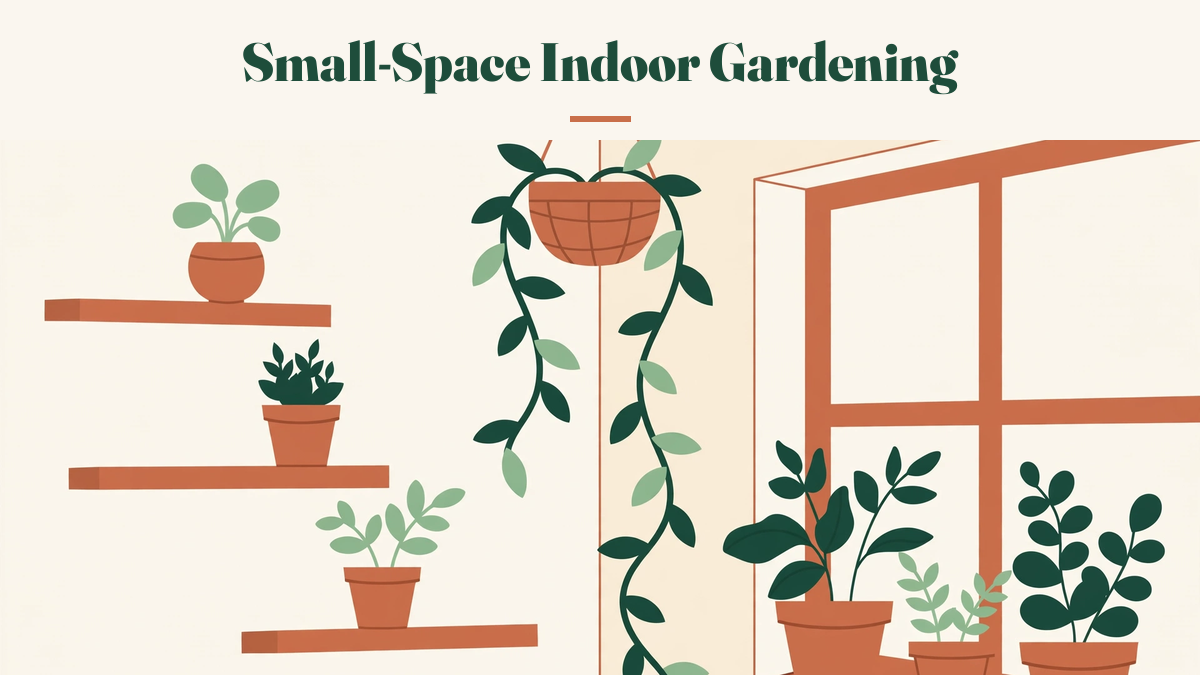
Wall shelves. One 120cm shelf holds five to seven plants and takes zero floor space. Two shelves on the same wall hold a dozen. Mount them near a window — light falls off fast with distance, and a shelf on the opposite wall from the window is a low-light shelf no matter how bright the room feels. My guide to styling a plant shelf covers the arrangement; the small-space point is that shelves turn dead wall into growing space.
Hanging planters. A hanging plant uses air, not floor or shelf. One hook in the ceiling holds a trailing pothos or spider plant that would otherwise need a shelf to itself. In a rental, a ceiling hook leaves a small hole that filler repairs in minutes — but if you'd rather not drill, tension rods across a window frame, over-door hooks, and tall plant stands all hold hanging plants without a single hole. My guide to hanging plants covers the safety side, including the weight problem: a watered hanging plant is heavier than you'd think, and a hook rated for the dry weight will fail when the plant is soaked.
Tall, narrow plants. One tall plant uses the same floor area as a small one and fills ten times the visual space. A snake plant in a tall pot, a fiddle-leaf fig in a corner, or a monstera on a moss pole all grow up rather than out. In a small flat, one large statement plant has more impact than six small ones scattered around — and it's easier to care for, because there's one plant to water, not six.
The tops of furniture. The top of a wardrobe, a bookcase, or a kitchen cabinet is wasted space until a trailing plant lives there. Pothos is the classic: it trails down the front, it tolerates the lower light up high, and it turns dead space into a feature. Just remember you'll need a step stool to water it — I keep a small watering can with a long spout for exactly this job.
The windowsill is prime real estate
In a small flat, the windowsill is the most valuable growing space you have — it's the brightest spot, and it's usually the only place that gets direct light. Treat it that way. The sill earns its keep only if the plants on it actually need the light.
My windowsill is 90cm wide, and it holds four plants: a jade plant and a string of pearls at the bright end, a small cactus in the middle, and a spider plant at the other end. That's it. Four plants, each one chosen because it wants the light the sill provides. The pothos that used to live there moved to a shelf — it tolerates lower light, so it was wasting the brightest spot in the flat.
The light audit matters here more than anywhere. Clemson Extension measures indoor light in foot-candles: low-light plants need about 100, medium-light plants 200–500, and high-light plants 500–1,000. The interior of a well-lit home is often less than 100 foot-candles — and light falls off dramatically with distance from the window. A plant on the sill might get 2,000 lux while the same plant a metre into the room gets 400. I measure with a phone light-meter app (a foot-candle is roughly 10 lux) and assign the sill to the plants that need the most light, not the plants I like most.
Rotate the sill plants weekly — a quarter turn each time you water — so they grow evenly instead of leaning toward the glass. And in winter, check that the sill isn't cold: a plant pressed against freezing glass in January will suffer, even if the room is warm. A centimetre of air between the pot and the pane makes a difference.
A worked plan: four spots, one small flat
Here's how the flat is actually planted — four growing spots, each with a job, each chosen for its light. This is the plan the audit produced, and it's the one I'd hand to anyone starting from scratch in a small space.
| Spot | Light | What lives there | Why it works |
|---|---|---|---|
| Windowsill (90cm, east-facing) | Bright, morning sun | Jade plant, string of pearls, small cactus, spider plant | The brightest spot goes to the plants that need it most; four plants, no crowding |
| Wall shelf (120cm, near the window) | Bright indirect | Pothos (trailing), peace lily, ZZ plant, small fern | The workhorse shelf — medium-light plants, varied heights, one trail over the edge |
| Hanging planters (2 hooks, by the window) | Bright indirect | Spider plant, trailing philodendron | Uses air, not floor; the trails frame the window and draw the eye up |
| Floor corner (by the sofa) | Low to medium | Snake plant in a tall pot | One statement plant fills the corner; tolerates the lower light; upright shape doesn't crowd the sofa |
The plan uses no floor space except one corner, no working surfaces, and no shelf that isn't near the window. Every plant is in light it can handle, and every spot has a clear job. The total maintenance is about thirty minutes a week — mostly watering, which I do in one round with a tray to catch drips.
The plan also has room to grow, which matters: a shelf with a gap is a shelf that can take a new plant without displacing anything. I keep one gap on the wall shelf deliberately — it's the space the next plant goes into, and when it's full, the one-in-one-out rule kicks in.
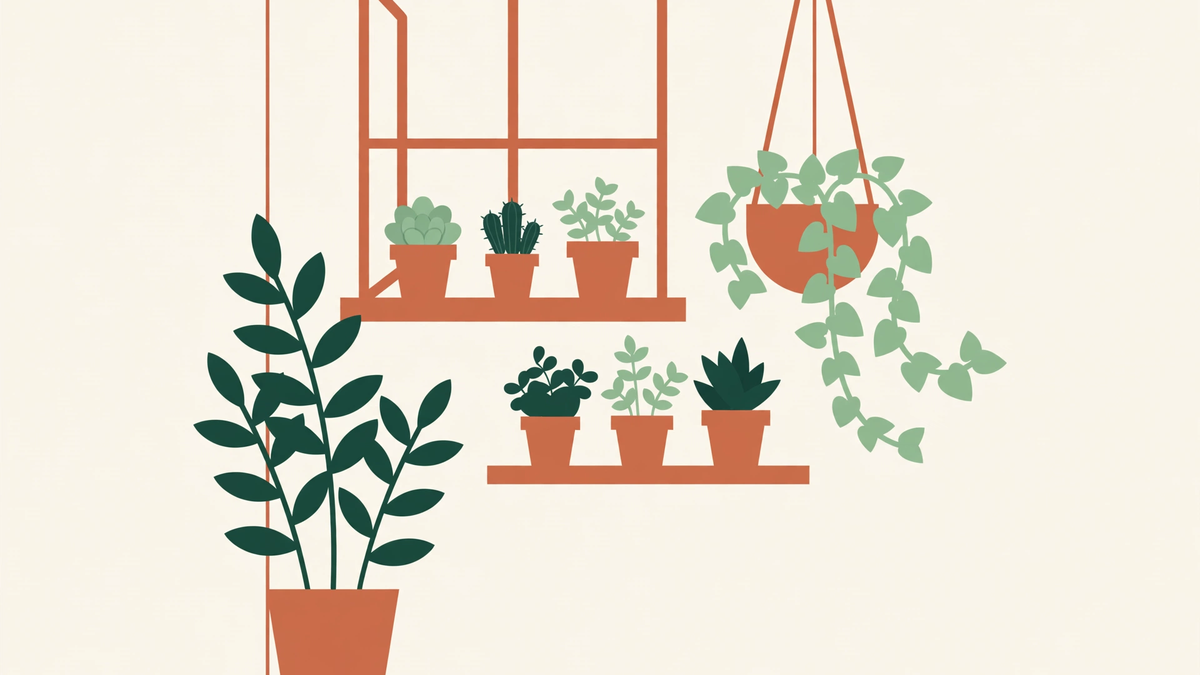
Small plants, big impact
In a small flat, plant choice matters more than plant count. A few principles that have served me well:
Compact plants beat sprawling ones. A pilea, a small fern, or a baby monstera gives you the look of a much larger plant in a fraction of the space. Avoid plants that sprawl sideways — a mature spider plant with plantlets hanging in every direction needs more room than a small flat can give it.
Trailing plants are space-efficient. A pothos in a hanging planter occupies a few centimetres of ceiling and fills a metre of vertical air with green. Clemson notes pothos prefers bright indirect light but tolerates lower light, and it prefers 50–70% humidity — which a small, lived-in flat usually provides. It's the highest-impact plant per centimetre in my flat.
One statement plant anchors a room. A single large plant — a monstera, a fiddle-leaf fig, a bird of paradise — makes a small room feel designed in a way that ten small plants can't. It gives the eye a focal point and it makes the smaller plants read as a collection rather than clutter. Choose it for the light you have, not the light you wish you had: a fiddle-leaf fig in a dim corner is a slow tragedy, but a snake plant in the same corner is a sculpture.
Repeat, don't scatter. Three pothos in three spots look like a theme. Three different trailing plants in three spots look like a jumble. Repeating one or two plants across the flat — the same pothos on the shelf and in the hanging planter, the same snake plant in two rooms — makes the whole flat feel coordinated. It's the plant equivalent of repeating a colour in a room.
The small-space problems nobody warns you about
Small flats create problems that big houses don't, and they're all about density.
Pests spread faster. In a small flat, every plant is within a metre or two of every other plant. A spider mite outbreak on one shelf reaches the windowsill within days. Quarantine new plants — even in a small flat, a bathroom windowsill works as a quarantine spot — and check the whole collection weekly, because early detection is the only thing that works at this density.
Humidity builds up. A small flat with lots of plants and daily showers can get genuinely humid, which most tropical plants love — but it also means soil dries slowly, so overwatering is a bigger risk than in a large, dry house. Check the soil before every watering, and ventilate daily. If condensation is running down the windows every morning, the flat is too humid for the building, whatever the plants think.
Light competition is real. Plants on a crowded shelf shade each other. The plant in the middle of a packed shelf gets a fraction of the light the plants at the ends get, and it declines slowly while everything around it thrives. Space plants so light reaches all of them — if you can't see the shelf surface between the pots, they're too close together.
Watering gets messy. A small flat has less room for drips, spills, and saucers. I water over the sink or the bath where possible, and I keep a tray under the shelf plants for the ones I water in place. A watering can with a narrow spout is worth its weight in a small space — it puts water in the pot, not on the shelf, the books, or the floor.
Keeping it under control
A small-space collection needs regular editing, or it grows back into clutter. My routine:
Monthly: a quick audit — is every plant thriving, is every spot earning its keep, is anything shading its neighbour? Move or rehome anything that fails.
Seasonally: a light check. Light changes through the year, and a spot that's bright in summer can be dim in winter. I re-measure with the phone app when the clocks change and shuffle plants if the numbers have shifted.
When a plant outgrows its spot: prune it, propagate the cuttings, or move it to a bigger home. A pothos that's outgrown its shelf becomes cuttings for the hanging planter and a gift for a friend. Growth is the point — but in a small flat, growth has to be managed, not just celebrated.
When you want a new plant: apply the one-in-one-out rule. The new plant earns its spot by displacing something — and the displaced plant goes to a friend, not the bin. My collection stays the same size, but it gets better every year, because each new plant is a deliberate choice rather than an impulse.
Frequently asked questions
How many plants can fit in a small flat?
More than you'd think, if you go vertical. Shelves, hanging planters, and windowsills multiply your growing space without taking floor area — but every plant still needs adequate light.
What are the best plants for a small flat?
Compact and trailing plants: pothos, ZZ plant, snake plant, spider plant, pilea, and small ferns. One large statement plant works better than several medium ones competing for floor space.
How do I grow plants with only one window?
Prioritise the windowsill for light-hungry plants, use shelves near the window for medium-light plants, and put low-light tolerators further in. A grow light extends what one window can support.
Do hanging plants damage ceilings in a rental?
A ceiling hook leaves a small hole that filler repairs in minutes. For a no-damage option, use tension rods, over-door hooks, or tall plant stands instead.
How do I stop a small flat feeling overrun by plants?
One plant in, one plant out. Group plants into deliberate clusters rather than scattering them, and leave some surfaces bare — empty space is what makes a collection look designed.
If you remember one thing… go up, not out — shelves, hanging planters, and one tall statement plant give a small flat a big collection without losing a single centimetre of floor to it.