If you've killed every plant you've ever owned, I have good news and better news. The good news: it's almost certainly not because you have a "black thumb". The better news: the plants on this list are chosen specifically for people in your position — people who forget to water, whose flats are dimmer than they'd like, and who have been burned by a fiddle-leaf fig that arrived looking like a showroom plant and died within a month.
I've killed plenty of plants myself. A calathea crisped on a sunny sill, a fern dried out in a week, a string of pearls rotted because I watered it like a pothos. The difference between then and now isn't a magical green thumb — it's that I stopped buying plants that needed an expert and started buying plants that forgive a beginner. The ten plants below are the ones I'd hand to anyone who says "I kill everything". They've all survived my own neglect at various points, and they're the plants I still recommend first.
Why your plants actually died
Before the list, a quick diagnosis — because buying a forgiving plant helps, but understanding what went wrong helps more. In my experience, almost every beginner plant death comes down to one of three causes, and the first one accounts for most of them.
1. Overwatering. The number one killer, by a long way. It feels counterintuitive — surely more water means a happier plant? — but most houseplants die from too much water, not too little. Wet soil suffocates the roots, they rot, and the plant collapses. The tragedy is that an overwatered plant looks thirsty — drooping, yellowing leaves — so people water it more, and the rot accelerates. The guide to how to water houseplants covers the finger test in detail, but the short version is: check the soil before you water, every time, and when in doubt, wait.
2. Too little light. A plant that needs bright indirect light will slowly starve in a dark corner. It doesn't die dramatically — it just stops growing, drops leaves one by one, and fades over months. The fix is either a brighter spot or a plant that genuinely tolerates low light, which several on this list do.
3. The wrong plant for your life. Some plants are simply not beginner plants, however beautiful they look in the shop. Calatheas want humidity your flat doesn't have. Fiddle-leaf figs sulk at every change. Maidenhair ferns need constant moisture. Buying one of those as a first plant is like learning to drive in a racing car — the failure isn't your fault, it's the choice of vehicle.
This table is the quickest way to diagnose what happened to your last plant:
| What you saw | Most likely cause | What to do differently |
|---|---|---|
| Yellow, mushy leaves; wet soil that never dries | Overwatering / root rot | Water only when the top soil is dry; use a pot with holes |
| Drooping, dry crispy leaves; bone-dry soil | Underwatering | Check soil weekly; water thoroughly when dry |
| Leggy stems, small pale leaves, no growth | Too little light | Move closer to a window or pick a low-light plant |
| Brown crispy leaf edges | Low humidity or chemicals in tap water | Group plants together; try filtered water |
| Sudden leaf drop after moving the plant | Shock from a change | Keep the plant in one spot; changes take weeks to show |
| White fluffy spots or tiny webs | Pests (mealybugs or spider mites) | Isolate the plant; wipe leaves; treat early |
What makes a plant beginner-proof?
Not all "easy" plants are equally easy. When I was putting this list together, I judged every candidate against four tests — and only plants that passed all four made the cut.
It tolerates irregular watering. A beginner-proof plant survives both a missed watering and an over-enthusiastic one. The best of them store water in thick leaves, stems, or rhizomes, so they carry their own reserves.
It tolerates imperfect light. Your flat's light is what it is. A beginner plant should cope with a bright windowsill and a spot a couple of metres back from the window, without sulking in either.
It shows problems slowly and clearly. The worst beginner plants die without warning. The best ones signal trouble early — a droop, a curl, a colour change — and give you days or weeks to fix it.
It's cheap and easy to replace. This matters more than people admit. A £5 pothos that dies teaches you something; a £60 fiddle-leaf fig that dies teaches you to never buy a plant again. Every plant on this list is widely available and inexpensive.
The ten plants I'd start with
Here they are, in the order I'd recommend them — toughest first. Each one passes all four tests above, and each one I've personally grown through at least one bout of neglect.
1. Snake plant (Sansevieria trifasciata). The toughest houseplant I know. It stores water in its thick leaves, tolerates low light, and can go a month without water in winter. I've left one unwatered for six weeks while travelling and come home to a plant that looked exactly the same. Its one weakness is wet feet — water it only when the soil is fully dry, and never let it sit in a puddle. Iowa State Extension calls it "nearly indestructible", and the RHS lists it as low-maintenance and ideal for beginners.
2. ZZ plant (Zamioculcas zamiifolia). The snake plant's equal in toughness, with glossy leaves and a completely different look. It stores water in underground rhizomes — thick, potato-like structures — which is why it survives drought so well. It grows slowly, which is a feature for a beginner: nothing happens fast, so nothing goes wrong fast. If you're torn between the two toughest plants on this list, snake plant vs ZZ plant compares them head to head.
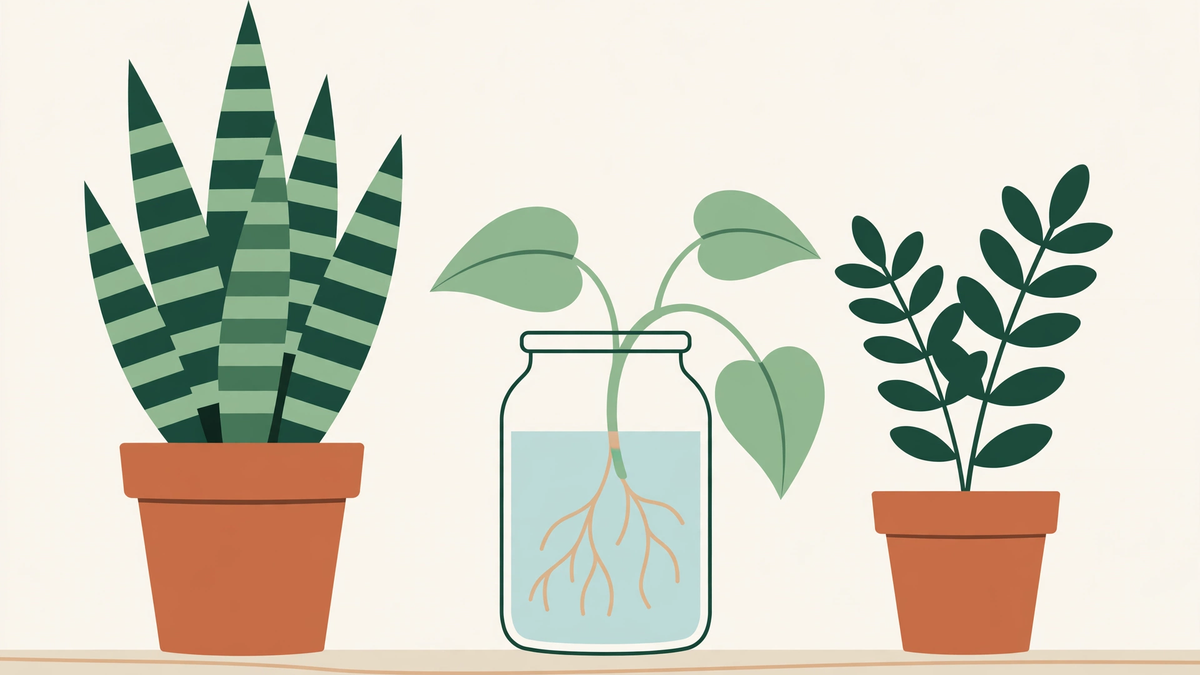
3. Golden pothos (Epipremnum aureum). The classic beginner plant, and for good reason. It trails beautifully, grows fast enough to be rewarding, tolerates low light, and tells you when it's thirsty by drooping — then perks up within hours of a drink. It also propagates effortlessly from cuttings, so one plant becomes many. Mine started as a single cutting in a jar of water and now trails two metres across a shelf. If you buy only one plant from this list, make it this one.
4. Spider plant (Chlorophytum comosum). Another forgiving classic. It tolerates a wide range of light, forgives irregular watering, and produces baby plantlets on long stems that you can pot up for free plants — I must have given away several spider plant babies over the years, all from one parent plant. The only common complaint is brown leaf tips; in my experience, switching to filtered water usually fixes them.
5. Chinese evergreen (Aglaonema). The best low-light plant most beginners have never heard of. It thrives in dim corners where other plants fade, needs little water, and comes in varieties with silver, pink, and red variegation. It grows slowly and steadily, and it asks for almost nothing in return. I keep one in a north-facing hallway that gets no direct sun at all, and it has put out new leaves every year without a single complaint.
6. Jade plant (Crassula ovata). A succulent with a tree-like habit — thick trunk, plump leaves, and the potential to live for decades. It wants a bright windowsill and very little water, which makes it ideal if you tend to forget. Water it only when the soil is dry and the leaves feel slightly soft. Overwatering is its only real enemy.
7. Peace lily (Spathiphyllum). The drama queen of this list, and I include it deliberately: a peace lily droops spectacularly when thirsty, then recovers within hours of watering. That visible signal teaches a beginner the watering rhythm faster than any guide — you learn to read the plant instead of the calendar. It also flowers in low light and tolerates a missed watering better than its dramatics suggest. Just keep it away from curious pets: the ASPCA lists peace lily as toxic to cats and dogs, as chewing the leaves releases irritating calcium oxalate crystals.
8. Rubber plant (Ficus elastica). A statement plant that's far easier than it looks. Big glossy leaves, upright growth, and a tolerance for both bright and medium light. Wipe the leaves occasionally to keep them shiny, water when the top soil dries, and it will grow steadily for years — mine has gone from a 30 cm cutting to a metre-tall plant in three years with nothing more than regular watering and an annual repot. The burgundy variety is particularly striking and just as easy.
9. Dracaena marginata. Tall, architectural, and almost impossible to kill by neglect. It tolerates low light, dry air, and irregular watering, and its thin trunks with spiky leaves suit a modern room. Brown tips are the common complaint — in my experience, filtered water helps if your tap water is heavily treated.
10. Philodendron brasil. A trailing plant with heart-shaped leaves splashed in lime green, and nearly as tough as pothos. It grows fast, tolerates medium light, and looks beautiful on a shelf or in a hanging pot. If pothos feels too familiar, this is the upgrade — same forgiving nature, more interesting foliage. The two are often confused, so pothos vs philodendron explains how to tell them apart.
The forgiveness table
If you want to compare them at a glance, this is the summary I use when someone asks me to pick for them:
| Plant | Light | Water | Forgiveness | Watch out for |
|---|---|---|---|---|
| Snake plant | Low–bright | Every 3–6 weeks | ★★★★★ | Overwatering |
| ZZ plant | Low–bright | Every 3–6 weeks | ★★★★★ | Overwatering |
| Golden pothos | Low–bright | Every 1–2 weeks | ★★★★★ | Almost nothing |
| Spider plant | Medium–bright | Every 1–2 weeks | ★★★★ | Brown tips |
| Chinese evergreen | Low–medium | Every 2–3 weeks | ★★★★ | Cold draughts |
| Jade plant | Bright | Every 2–4 weeks | ★★★★ | Overwatering |
| Peace lily | Low–medium | Every 1–2 weeks | ★★★★ | Dramatic drooping |
| Rubber plant | Medium–bright | Every 1–2 weeks | ★★★★ | Overwatering |
| Dracaena marginata | Low–bright | Every 2–3 weeks | ★★★★ | Brown tips |
| Philodendron brasil | Medium–bright | Every 1–2 weeks | ★★★★ | Cold rooms |
The stars are my own judgement, not a scientific measure — but they reflect years of watching which plants survive a beginner's real life, and which ones quietly give up.
A six-week experiment: what happens when you neglect them?
I don't just claim these plants are forgiving — I tested it, unintentionally at first and then on purpose. A few years ago I went away for six weeks and left a group of plants with no watering at all. When I came back, the results were a perfect illustration of why plant choice matters more than plant care.
The snake plant and ZZ plant looked untouched — not a single yellow leaf between them. The pothos had drooped and lost two leaves, but perked up within a day of watering and was growing again within a week. The spider plant had brown tips on its oldest leaves but was otherwise fine, and the Chinese evergreen had simply paused — no new growth, no damage, just waiting. The jade plant's leaves had gone slightly soft and wrinkled, which is its way of saying "I'm using my reserves", and they plumped back up after two waterings.
The plants that didn't survive the experiment weren't on this list. A calathea and a fern were both gone, and a fiddle-leaf fig had dropped most of its leaves. The lesson was clear: if your life involves travel, busy periods, or simply forgetting, the plant you choose matters far more than the care routine you plan. Choose a plant that can wait, and the gaps in your care stop being emergencies.
I've since repeated the test deliberately — not for six weeks, but by watering the forgiving group only when I happened to notice they needed it, with no schedule at all, for three months. The snake plant got watered twice in that period. The pothos got watered when it drooped, which was about every ten days. The peace lily was the neediest of the group, drooping every week or so, but it recovered every time. None of them died, none of them lost more than a leaf or two, and all of them were growing by the end of the three months. That is what beginner-proof actually means: not that the plant thrives on neglect, but that neglect doesn't kill it.
Your first week with a new plant
Buying the right plant is half the job. The first week is the other half — it's when most beginner mistakes happen, usually from too much enthusiasm. Here's the checklist I give friends who've just brought a plant home:
Day 1 — Find its spot and leave it there. Put the plant where it will live — near a bright window but out of direct sun, away from radiators and cold draughts. Then resist the urge to move it. Plants take weeks to adjust to a new home, and moving them around resets the clock every time.
Day 1 — Check the soil, don't just water it. Shop plants are often soaking wet or bone dry. Push a finger 2–3 cm into the soil. If it's damp, leave it alone. If it's dry, water it thoroughly until water runs out of the drainage holes, then let it drain fully.
Day 2–3 — Look, don't fuss. Check the leaves for pests — tiny webs, white fluff, or small dots on the undersides. A quick look now saves a collection-wide problem later. Don't repot yet, don't feed it, don't prune it. Let it settle.
Day 7 — The first proper check. Check the soil again. If the top 2–3 cm is dry, water. If it's still damp, wait. This weekly check is the single most important habit in houseplant care — more important than any product or gadget.
Week 2 and beyond — Settle into the rhythm. Water only when the soil says so, rotate the pot a quarter-turn every couple of weeks so the plant grows evenly, and wipe dusty leaves with a damp cloth once a month. That's the whole routine. The first 30 days checklist walks through the full first month in more detail, including when to repot and when to start feeding.
The starter kit
You don't need much. Here's what I'd buy alongside a first plant, with rough prices from a garden centre — the whole kit costs less than a single fiddle-leaf fig:
| Item | Why you need it | Rough cost |
|---|---|---|
| Pot with drainage holes | The plant's home; holes prevent root rot | £3–£8 |
| Saucer or drip tray | Catches water; protects your furniture | £1–£3 |
| Bag of indoor potting mix | Better drainage than the shop's dense soil | £5–£8 |
| Small watering can | A narrow spout gives you control | £5–£10 |
| Spray bottle (optional) | For wiping leaves, not for misting | £2–£3 |
| Total | £16–£32 |
What you don't need yet: fertilizer (wait until the plant is settled and growing), a moisture meter (your finger works fine), grow lights (only if you have no bright window at all), or decorative moss and pebbles (they trap moisture and hide the soil, which is the opposite of what a beginner needs).
One more thing worth buying early: a second pot, one size up from the one your plant came in. Not to use now — to have ready for when the plant outgrows its nursery pot in six months or a year. Having the right pot on hand means you repot when the plant is ready, not when you happen to be near a garden centre, and it stops the classic beginner move of repotting into whatever oversized pot happens to be on sale.
The mistakes that still get beginners
Even with a forgiving plant, there are a few traps. These are the ones I see most often:
Watering on a schedule instead of checking the soil. "Every Sunday" sounds disciplined, but a plant's water needs change with the season, the room, and the pot. In winter a snake plant might go six weeks without a drink; in summer the same plant might want water every three. The finger test takes five seconds and it's always right.
Repotting too soon. A new plant does not need a bigger pot on day one. Shop plants are usually in the right size pot for now, and repotting is a stress event — it disturbs the roots just when the plant is adjusting to a new home. Wait at least a month, and only repot when roots are visibly circling the drainage holes.
Buying the plant for the spot, not the spot for the plant. The dark corner of the living room is where you want a plant, but it's not where most plants want to be. Either put a genuinely low-light plant there — snake plant, ZZ, Chinese evergreen — or put the plant somewhere brighter and accept that the dark corner stays empty.
Feeding a struggling plant. Fertilizer is not medicine. A plant that's drooping, yellowing, or dropping leaves is almost never short of fertilizer — it's usually overwatered, underlit, or shocked. Feeding it adds chemical stress on top of whatever is already wrong. Feed only healthy, actively growing plants, and only in spring and summer.
Giving up too early. A plant that drops a few leaves in its first weeks isn't dying — it's adjusting. A pothos that looks bare after a move will fill in within a month or two. Plants work on a slower clock than we do, and patience is the cheapest plant-care tool there is.
Starting your collection
Once your first plant has survived a few months, you'll know what your home offers — how much light you really have, how often you remember to water, which rooms stay warm. That's the information that lets you choose a second plant well, and a third.
My suggestion: start with two or three plants from this list, in different spots. A snake plant in the dim corner, a pothos on a shelf, a peace lily in the bathroom. Watch them for a season. The one that thrives tells you what your home is good at; the one that struggles tells you what to avoid. Either way, you're learning — and this time, the plants are built to survive the lesson.
And when you're ready to branch out — a monstera, a calathea, something with a reputation — you'll be doing it with a track record behind you. You'll know your light, you'll know your watering rhythm, and you'll know the difference between a plant that's adjusting and a plant that's dying. That's the real beginner's milestone: not keeping one plant alive, but knowing why it's alive.
Frequently asked questions
What is the easiest houseplant for a complete beginner?
Snake plant or ZZ plant. Both survive missed waterings, low light, and neglect for weeks, and they tell you clearly when something is wrong.
Why do I keep killing my houseplants?
Usually one of three things: overwatering (the top killer), too little light, or a fussy plant that never suited your home. Fix the watering first — it solves most deaths.
How often should a beginner water houseplants?
Check the soil, not the calendar. Push a finger 2–3 cm into the soil: if it's dry, water; if it's damp, wait. Most beginner plants need water every 1–2 weeks in the growing season; succulents like jade go longer between waterings.
Can I keep houseplants in a dark flat?
Yes, if you choose genuinely low-light plants like snake plant, ZZ plant, and Chinese evergreen. But no plant survives with zero natural light — a bright windowsill nearby helps.
Should beginners start with one plant or several?
Start with two or three different easy plants. If one struggles, the others teach you what works — and you learn faster by comparing them.
What should I buy with my first houseplant?
A pot with drainage holes, a saucer, a bag of indoor potting mix, and a small watering can. That's the whole starter kit — everything else is optional.
If you remember one thing… the plant isn't the problem — the match is. Pick a plant that forgives your real life, check the soil before you water, and give it a few months before you judge yourself.