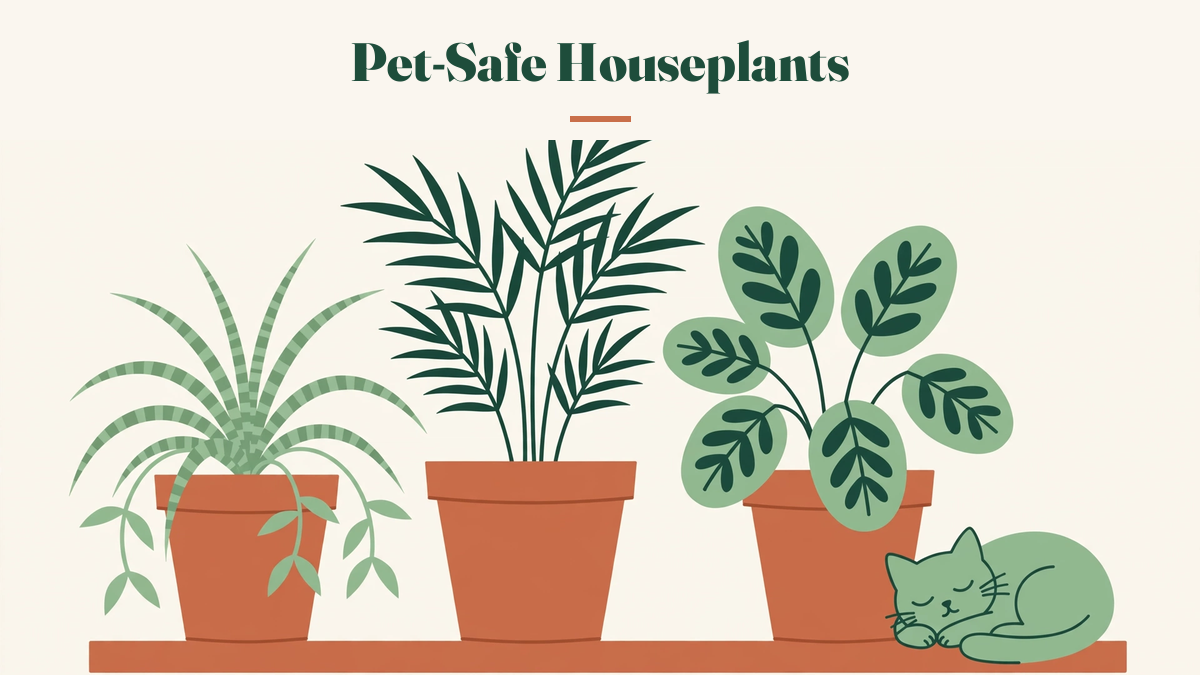
I once brought home a beautiful calathea, set it on a low shelf, and watched a cat walk straight over, take one thoughtful bite out of a leaf, and keep walking. The plant survived. The cat was fine. But it was the moment I realised that in a home with animals, every plant choice is also a safety choice — and that I'd been lucky, not careful.
That was years ago, and since then I've rebuilt my collection around a simple rule: if a plant is within reach of a curious mouth, it needs to be non-toxic. Not "mildly toxic", not "toxic but they'd have to eat a lot" — non-toxic, as listed by the ASPCA. The good news is that the list of beautiful, genuinely pet-safe plants is much longer than most people think. You don't have to choose between a green home and a safe one.
This guide covers the plants I'd actually trust around cats and dogs, the dangerous ones to keep out of reach (or out of the house entirely), how to check any plant yourself, and what to do if your pet eats something anyway.
One important note before we start: pet-safe lists are guidance, not a guarantee. Every animal is different, and even a non-toxic plant can cause an upset stomach if a pet eats a lot of it. If your pet eats any plant and seems unwell, check with your vet — don't rely on a list. And "non-toxic" doesn't mean "edible": it means the plant isn't poisonous, not that it's a snack.
What "pet-safe" actually means
When I say a plant is pet-safe in this guide, I mean it's listed as non-toxic to cats and dogs by the ASPCA (the American Society for the Prevention of Cruelty to Animals), which maintains the most widely used toxic and non-toxic plant database. That's the standard I check every plant against, and it's the standard I'd recommend you use too.
A few things the label doesn't mean:
- Non-toxic doesn't mean harmless in any quantity. A cat that eats half a spider plant may still vomit — not because the plant is poisonous, but because eating a lot of any plant fibre upsets a carnivore's stomach. The risk is a mess on the carpet, not a trip to the emergency vet.
- "Mildly toxic" still means toxic. Plants like pothos and monstera contain calcium oxalate crystals that cause mouth pain, drooling, and vomiting. They're rarely life-threatening, but they're genuinely unpleasant for the animal — and a pet in pain may keep chewing, making it worse.
- Cats and dogs are different. Some plants are safe for dogs but dangerous for cats, and vice versa. True lilies are the starkest example: a nibble that a dog might shake off can cause fatal kidney failure in a cat. Always check for your specific animal.
- The list changes as knowledge grows. The ASPCA database is updated as new cases come in. If you're unsure about a plant, check the current listing rather than trusting a blog post — including this one.
How to check any plant in 30 seconds: search the ASPCA toxic and non-toxic plant list for the plant's botanical name (not the common name — common names are unreliable). If it's listed as non-toxic to cats and dogs, you're good. If it's listed as toxic, keep it out of reach or out of the house. If it's not listed at all, treat it as unknown and keep it out of reach until you can verify it.
The trailing plants: green that hangs out of reach
Trailing plants are a natural fit for pet homes, because they can hang from the ceiling or sit on a high shelf where most pets can't reach them — and the ones below are safe even if a determined cat does get to them.
Spider plant (Chlorophytum comosum)
The classic pet-safe plant, and for good reason. Spider plants are completely non-toxic, famously tough, and they produce dangling baby plantlets that cats find irresistible — which is the one problem. Cats love batting and chewing the babies, so expect some ragged edges. The plant won't mind much, and the cat won't be harmed. Hang it high and let it trail. Full care guide: spider plant care.
Hoya (wax plant)
Hoyas are non-toxic, slow-growing, and produce clusters of waxy, star-shaped flowers when they're happy. They're ideal for a hanging basket or a high shelf — they like to trail or climb, and they prefer to dry out between waterings. The thick, waxy leaves seem to put most cats off chewing, which is a bonus.
Peperomia Hope and other trailing peperomias
Peperomias are one of the safest plant families for pets — the whole genus is non-toxic. Trailing varieties like Peperomia Hope have round, succulent-like leaves on cascading stems and look lovely in a hanging pot. They need very little water and cope with medium light.
Swedish ivy (Plectranthus verticillatus)
Despite the name, this isn't a true ivy — and unlike true ivy, it's non-toxic. It's a fast-growing trailer with scalloped leaves and a fresh scent. It does well in a hanging basket in bright indirect light and is easy to propagate from cuttings.
The statement plants: big, beautiful, and safe
Pet-safe doesn't have to mean small. These are the plants that fill a corner or anchor a room — and none of them will harm a curious pet.
Parlor palm (Chamaedorea elegans)
The parlor palm is one of the few palms that's completely safe for cats and dogs, and it's a genuinely beautiful plant — soft, feathery fronds on slender stems, growing slowly to a metre or more. It copes with low light and likes humidity, so it does well in a bathroom or a dim corner. Keep the soil lightly moist.
Areca palm (Dypsis lutescens)
A bigger, bushier palm with arching fronds that makes a real statement in a bright room. Non-toxic to both cats and dogs. It likes bright indirect light and regular watering — it's thirstier than the parlor palm, and brown tips usually mean it wants more water or more humidity.
Money tree (Pachira aquatica)
The money tree's braided trunk and broad, hand-shaped leaves make it a popular statement plant, and it's non-toxic to pets. It likes bright indirect light and prefers to dry out between waterings. It grows slowly indoors, which means it stays a manageable size for years.
Ponytail palm (Beaucarnea recurvata)
Not a true palm, but a striking plant with a swollen trunk base and a fountain of long, narrow leaves. Non-toxic to cats and dogs, very drought-tolerant, and happy in bright light. The long leaves tempt cats to bat at them, but the plant is tough enough to take it.
Calathea (prayer plants and friends)
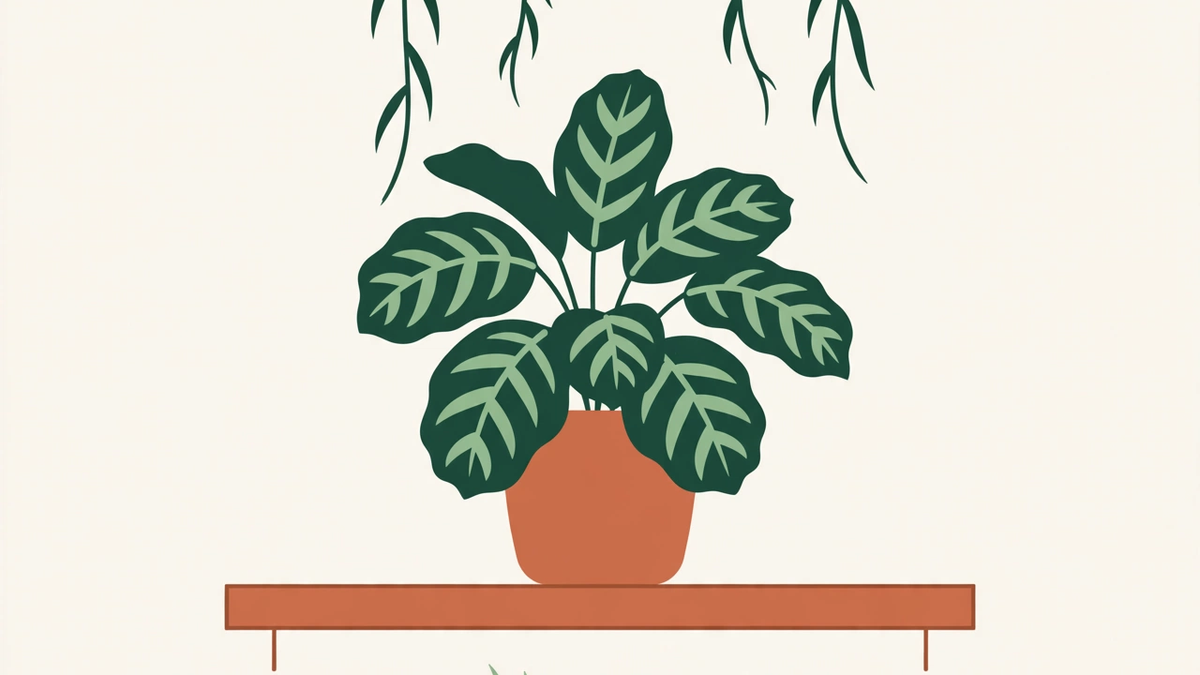
The whole calathea family — calathea, maranta, stromanthe, ctenanthe — is non-toxic to pets, which is wonderful news because they're some of the most beautiful foliage plants you can grow indoors. Their patterned leaves fold up at night and open in the morning. They need humidity and consistent watering, so they're not the easiest plants, but they're safe. Full guide: calathea care.
Banana plant (Musa)
If you want drama, a banana plant delivers — huge, paddle-shaped leaves on a fast-growing plant. It's non-toxic to pets and grows quickly in bright light. It needs a lot of water and a big pot, and it will outgrow a small room, but for a bright corner it's spectacular.
The small and shelf-friendly: safe plants for every surface
Not every pet-safe plant needs to be a statement. These are the ones for desks, shelves, and windowsills — small, pretty, and safe if a pet investigates.
Peperomia (all varieties). The entire peperomia genus is non-toxic, and it comes in an enormous range of shapes: round-leaved, ripple-leaved, trailing, upright. Peperomia obtusifolia (baby rubber plant) is the easiest — thick glossy leaves, very forgiving of missed waterings, happy in medium light.
Pilea peperomioides (Chinese money plant). Round, coin-shaped leaves on thin stems, and completely safe for pets. It produces pups around its base that you can pot up and share. Bright indirect light and water when the top soil dries.
African violet (Saintpaulia). One of the few flowering houseplants that's fully pet-safe. It blooms for months at a time in bright indirect light, in shades of purple, pink, and white. Keep water off the leaves (it spots them) and water from the bottom.
Boston fern (Nephrolepis exaltata). A lush, feathery fern that's non-toxic and loves humidity — a great bathroom plant. It needs consistent moisture and doesn't like drying out, but it's very forgiving of low light. Full guide: Boston fern care.
Air plants (Tillandsia). No soil, no pot, no problem. Air plants are non-toxic, and because they can be mounted on a wall or hung from a string, they're easy to keep out of reach entirely. Soak them in water for 20 minutes once a week.
Prayer plant (Maranta leuconeura). The classic prayer plant folds its patterned leaves up at night. Non-toxic, compact, and happy in medium light with regular watering. A beautiful desk plant.
Fittonia (nerve plant). Tiny, vividly veined leaves in green and pink or white. Non-toxic, loves humidity, and dramatic when thirsty — it faints flat and perks up within hours of watering. Perfect for a terrarium.
Phalaenopsis orchid (moth orchid). The most common indoor orchid is non-toxic to cats and dogs, and its long-lasting blooms make it a lovely pet-safe flowering plant. Bright indirect light, water sparingly, and don't repot while it's flowering.
The swap table: a safe plant for every toxic favourite
The hardest part of pet-safe planting is giving up the plants you love. This table matches popular toxic plants with safe plants that give you a similar look — so you don't have to give up the style, just the species.
| If you love… | It's toxic because… | Swap it for… | Why it works |
|---|---|---|---|
| Monstera deliciosa | Calcium oxalate crystals | Banana plant | Big, bold tropical leaves, non-toxic |
| Golden pothos | Calcium oxalate crystals | Hoya or Swedish ivy | Trailing habit, easy care, safe |
| Fiddle-leaf fig | Irritant sap | Money tree or areca palm | Tall statement plant, safe |
| Snake plant | Saponins — nausea, vomiting | Ponytail palm | Architectural, upright, drought-tolerant |
| Peace lily | Calcium oxalate crystals | African violet or phalaenopsis orchid | Flowering plant, safe, beautiful |
| Aloe vera | Saponins and anthraquinones | Haworthia | Thick succulent-like leaves, safe |
| ZZ plant | Calcium oxalate crystals | Cast iron plant | Tough, low-light, upright green |
| Jade plant | Unknown toxin — vomiting, lethargy | Peperomia obtusifolia or pilea | Thick-leaved, compact, safe |
| String of pearls | Mildly toxic if eaten | String of hearts or peperomia Hope | Trailing, decorative, widely regarded as safe |
| Dieffenbachia | Calcium oxalate — intense mouth pain | Calathea | Bold patterned foliage, safe |
A note on the swaps: some lookalikes are themselves toxic — split-leaf philodendron and Chinese evergreen, for example — so I've only listed swaps I'm confident are non-toxic. When in doubt, check the ASPCA list for the exact species before you buy.
Plants to keep away from pets
Some plants are dangerous enough that "out of reach" isn't enough — they shouldn't be in a pet home at all, or only with serious precautions.
True lilies (Lilium and Hemerocallis) — deadly to cats. This is the most important entry in this guide. All parts of a true lily — leaves, petals, pollen, even the water in the vase — can cause acute kidney failure in cats. A cat that brushes past a lily and grooms pollen off its fur can ingest enough to be fatal. If you have a cat, do not bring lilies into the house, not even as cut flowers. Daylilies are equally dangerous. (Peace lilies and calla lilies are different plants — irritant, not deadly — but the name causes dangerous confusion. When in doubt, skip anything with "lily" in the name.)
Sago palm (Cycas revoluta) — deadly to dogs and cats. Every part is toxic, especially the seeds. Even a small amount can cause liver failure. This is a plant to avoid entirely in a pet home.
Monstera, pothos, philodendron, dieffenbachia, peace lily — all contain calcium oxalate crystals that cause intense mouth pain, drooling, swelling, and vomiting. Rarely fatal, but genuinely distressing for the animal. Keep them high, hanging, or in a pet-free room.
ZZ plant, snake plant, aloe vera, jade plant — mildly to moderately toxic, causing nausea, vomiting, and diarrhoea. Not usually an emergency, but not plants to leave at pet height.
Kalanchoe, asparagus fern, oleander, cyclamen — all toxic to varying degrees. Cyclamen tubers are particularly dangerous if a dog digs them up.
The rule I follow: if a plant is deadly (lilies, sago palm), it doesn't come into the house at all. If it's irritant or mildly toxic, it goes high up, hanging, or behind a closed door — and I check regularly that it hasn't dropped leaves where a pet can reach them.
Placement: keeping plants and pets in harmony
Even with safe plants, placement matters — for the plant's sake as much as the pet's. A cat that chews a spider plant won't be harmed, but the plant will look ragged. A few strategies that work:
Go high. Hanging baskets, wall-mounted planters, and high shelves keep plants out of reach of most dogs and many cats. For cats, "high" needs to mean genuinely inaccessible — cats can jump further than you think, and a shelf next to a bookcase is a staircase. The guide to hanging plants that trail beautifully covers safe hanging in detail.
Use closed rooms. A spare room with a door is a perfect plant room for anything that's not pet-safe. Keep the door closed and the plants thrive without negotiation.
Provide alternatives. Cats chew plants partly out of curiosity and partly because they like greens. A pot of cat grass (wheatgrass or oat grass) gives them something safe to chew and often reduces interest in your other plants.
Make the soil unappealing. Dogs dig in pots; cats use them as litter trays. A layer of decorative stones or a piece of mesh over the soil surface discourages both. Citrus peels on the soil deter some cats (the smell, not the taste).
Check fallen leaves. Even a safe plant's fallen leaves can be a choking hazard for a small pet, and a toxic plant's fallen leaf is a hazard even if the plant itself is out of reach. Sweep up fallen leaves promptly.
A pet-safe room, planned: my living-room layout
To show how this all fits together, here's how I'd lay out a pet-safe living room — a typical bright room with a cat that investigates everything at floor level and a dog that mostly ignores plants unless they smell interesting. Every plant in this plan is non-toxic, so even if the cat reaches one, the worst outcome is a chewed leaf.
| Position | Plant | Why it works here |
|---|---|---|
| Floor, bright corner by the window | Areca palm | Big statement plant, safe at pet height, loves the light |
| Floor, dim corner by the sofa | Parlor palm | Tolerates the darker spot; fronds are out of the dog's way |
| Coffee table | Peperomia obtusifolia | Compact, safe, and heavy enough in its pot not to tip |
| Bookshelf, middle shelf | Pilea peperomioides | Coin leaves at cat-eye level — safe to bat at |
| Bookshelf, top shelf | Hoya, trailing down | Trails where the cat can't easily reach; non-toxic anyway |
| Hanging by the window | Spider plant | Babies dangle temptingly — safe to chew, plant survives it |
| Windowsill | African violet | Flowers for months; small enough that the cat ignores it |
| Side table | Calathea orbifolia | The showpiece — big patterned leaves, safe, likes the humidity near the room |
The total cost of this layout, buying modest-sized plants, is roughly what you'd spend on a single large monstera — and every plant in it is safe. The layout also follows the placement rules: the most tempting plants (the spider plant's dangling babies, the trailing hoya) are hung high, while the floor-level plants are the sturdy, uninteresting ones that pets tend to leave alone.
One thing I'd skip in this room: anything on the floor in a lightweight pot. A dog's wagging tail or a cat's enthusiastic leap can topple a small pot, and while the plant is safe, the mess and the broken pot aren't worth it. Heavy ceramic pots or a plant stand with a wide base solve the problem.
If your pet eats a plant anyway
Don't panic — but do act.
- Identify the plant. If you know the name, write it down. If not, take a photo. Your vet needs to know what the animal ate.
- Note how much was eaten and when. A single nibble is different from a whole leaf, and the timing matters for treatment.
- Check for symptoms. Drooling, pawing at the mouth, vomiting, lethargy, loss of appetite, difficulty breathing, or collapse. Any of these means call the vet now, not later.
- Call your vet. Describe the plant, the amount, and the symptoms. Follow their advice — don't try to make the animal vomit unless they tell you to.
- If you can't reach your vet, call the ASPCA Animal Poison Control Center (a consultation fee applies) or your local animal poison helpline. Keep the number saved in your phone before you need it.
If the plant was a lily and the animal is a cat, treat it as an emergency even if the cat seems fine — kidney damage can take a day or two to show symptoms, and early treatment makes a huge difference.
Frequently asked questions
Are spider plants safe for cats?
Yes. Spider plants are non-toxic to cats and dogs, though cats love chewing the leaves — the plant may suffer more than the cat.
Is monstera safe for pets?
No. Monstera contains calcium oxalate crystals that irritate the mouth and stomach. Keep it out of reach of cats and dogs.
What is the most dangerous houseplant for cats?
True lilies — even a nibble or pollen on the fur can cause kidney failure in cats. Keep lilies out of cat homes entirely.
Are all palms safe for pets?
No. Parlor palm and areca palm are safe, but sago palm is extremely toxic to dogs and cats — never bring one home.
My dog ate a plant leaf. What should I do?
Identify the plant, note how much was eaten, and call your vet. If you can't reach your vet, call the ASPCA poison helpline.
If you remember one thing… check the ASPCA list before you buy, keep lilies and sago palm out of the house entirely, and remember that pet-safe lists are guidance — your vet is the final word for your animal.