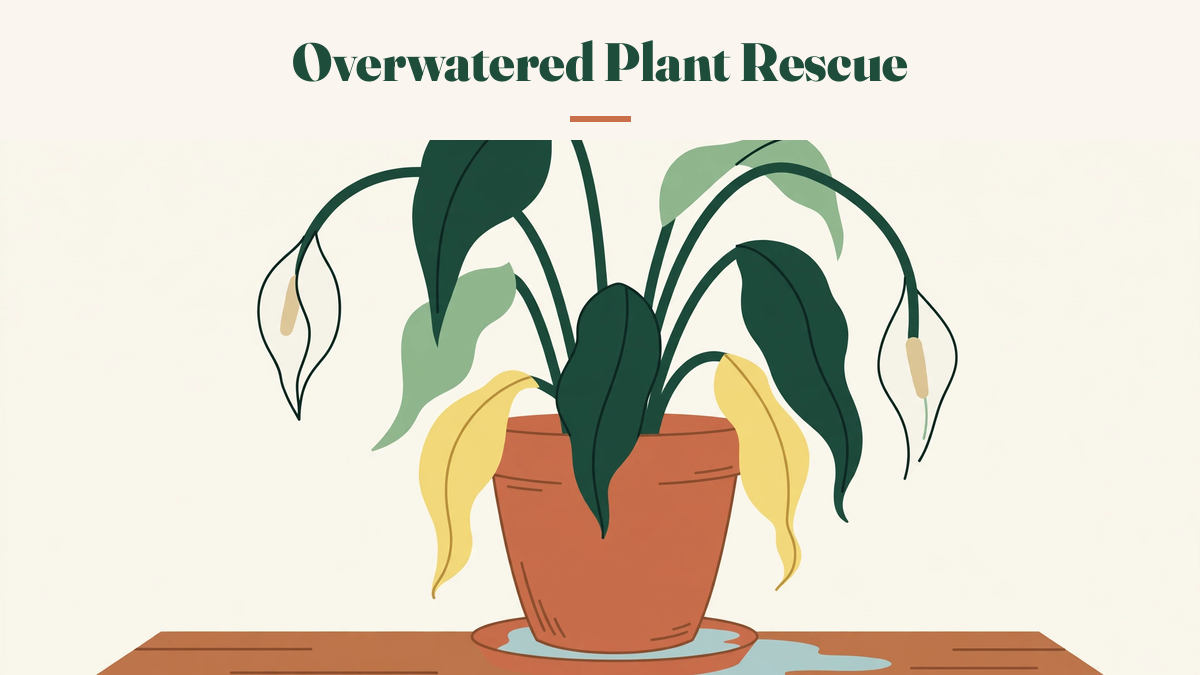
The peace lily on my kitchen shelf taught me about overwatering the hard way. It started drooping on a Tuesday, and I did what felt obvious: I watered it. By Thursday it was drooping worse, so I watered it again — a good soak this time, to be thorough. By the following Monday the lower leaves had gone yellow, the soil smelled faintly sour, and when I finally lifted the plant out of its pot I found the truth: the roots were brown and soft, the soil was a wet sponge, and my "help" had been drowning it for a week. The plant survived — peace lilies are forgiving — but it took two months to look like itself again, and I never water a drooping plant without checking the soil first now.
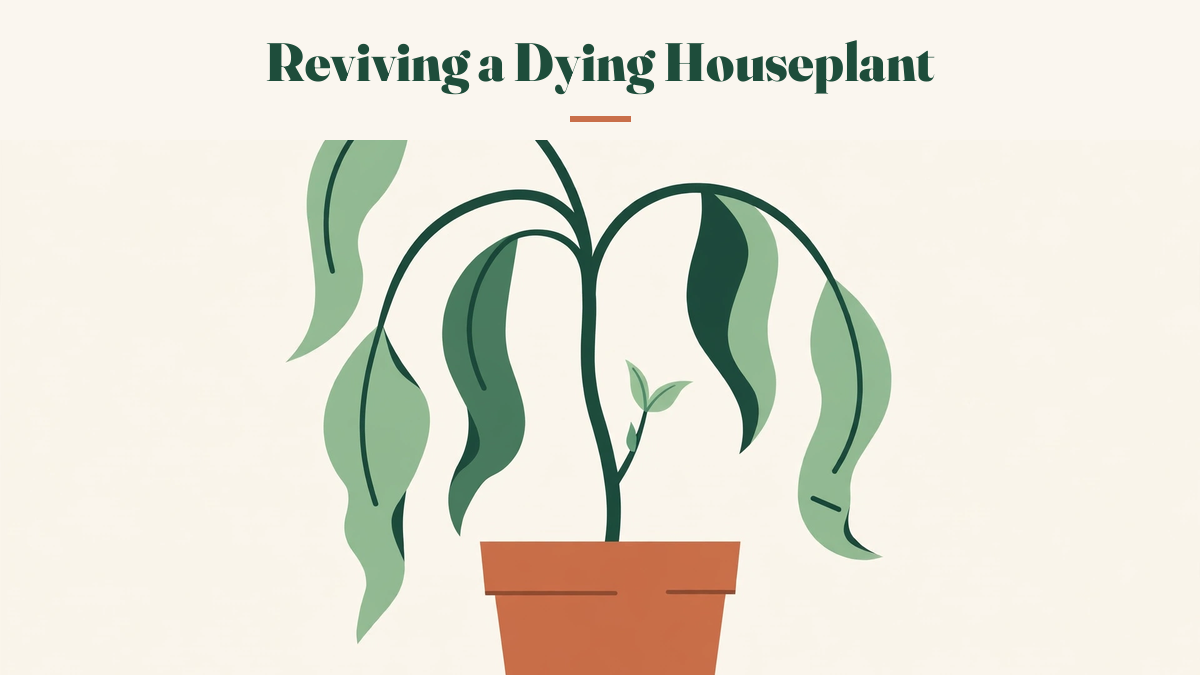
That is the trap at the heart of overwatering. A plant with drowning roots cannot take up water, so it droops and yellows exactly like a thirsty plant. The symptoms are the same; the soil is the only thing that tells them apart.
The one check that settles it
Before you do anything else, push a finger 5 cm into the soil.
- Soil wet, plant wilting: overwatered. The roots are short of oxygen or rotting, and they can't deliver water to the leaves. More water makes it worse.
- Soil dry, plant wilting: underwatered. The roots are fine but there's nothing to drink. Water thoroughly.
- Soil damp, plant wilting: check the drainage. The top may be damp while the bottom is waterlogged, or the pot may be sitting in a puddle.
If the finger test is ambiguous — the top feels dry but the plant still looks overwatered — lift the pot. A pot that's heavy for its size is holding water deep down. You can also slide a wooden skewer or chopstick down to the bottom of the pot and pull it out: if it comes out dark and damp, the lower soil is wet even if the surface is dry. I keep a bamboo skewer in my watering can for exactly this check, and it has saved me from more than one bad decision.
The signs, ranked by how much they matter
Not all overwatering signs are equal. Some are early warnings, some mean the roots are already in trouble. I rank them by severity, because the response depends on where your plant sits on this scale.
| Severity | Signs | What it means |
|---|---|---|
| Early | Soil stays wet for days after watering; pot feels heavy; growth slows | The plant is using less water than you're giving it. Fixable by adjusting your routine. |
| Mild | Lower leaves yellowing; a few leaves dropping; fungus gnats hovering | Roots are stressed and starting to suffer. Needs a dry-out period. |
| Moderate | Wilting despite wet soil; leaves soft and limp; stems feel weak | Roots are damaged and can't supply the plant. Needs intervention — drying out, possibly unpotting. |
| Severe | Sour or rotten smell from the soil; stems soft or black at the base; leaves collapsing | Root rot is advanced. Rescue means unpotting, trimming rot, and repotting into fresh mix. |
| Critical | Stem collapses at the base; the plant pulls out of the soil with no resistance | Most of the root system is gone. Take cuttings from any healthy growth — the main plant may not recover. |
The early signs are the ones to learn, because they're the ones that prevent the later ones. A pot that stays heavy for a week after watering is a plant telling you, politely, that it's getting too much. A sour smell is the same plant shouting. Listen at the polite stage and you'll rarely hear the shouting.
Two signs deserve a closer look. Fungus gnats — tiny dark flies hovering around the pot — are a reliable indicator of persistently wet soil, because their larvae live in the top few centimetres of damp mix. They don't cause the overwatering, but they're a visible symptom of it, and if you see them, the soil has been too wet for at least a couple of weeks. Yellow leaves on an overwatered plant follow a specific pattern: old and new leaves yellow and drop at the same time, which is different from the normal ageing pattern where only the oldest leaves go. If your plant is yellowing from the bottom and the top simultaneously, water is the prime suspect.
Overwatered vs underwatered, side by side
The two conditions share symptoms, so here's the direct comparison. When in doubt, work down this table — the soil and root columns are the most reliable.
| Clue | Overwatered | Underwatered |
|---|---|---|
| Soil | Wet at depth, stays wet for days | Dry at depth, may pull from the pot edge |
| Pot weight | Heavy for its size | Light for its size |
| Leaves | Yellow, soft, limp; may feel mushy | Dry, crispy edges; may curl inward |
| Wilting | Wilts even though the soil is wet | Wilts in dry soil; perks up after watering |
| Stems | Soft at the base, may darken | Firm, but the plant looks shrunken |
| Roots | Brown to black, soft, may smell bad | Pale and dry, may be brittle |
| Smell | Sour, musty, or rotten | No smell |
| Fungus gnats | Often present | Rarely present |
| Speed of decline | Slow at first, then sudden | Steady; the plant looks thirsty for days |
The row that matters most is the wilting row. A plant that wilts in dry soil and recovers within hours of watering was thirsty. A plant that wilts in wet soil and doesn't recover after watering has a root problem, and the fix is the opposite of what your instincts suggest.
Why wet soil kills: the oxygen problem
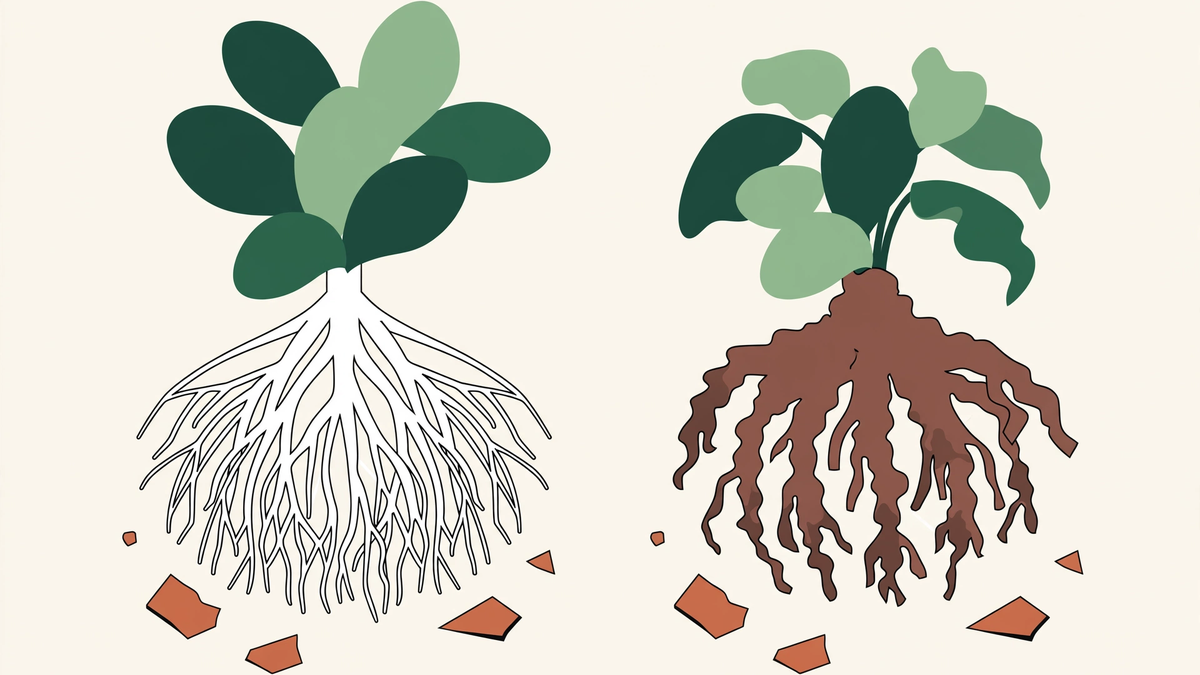
It seems strange that too much water can kill a plant that needs water to live, but the mechanism is straightforward. Roots need oxygen as well as water. In healthy soil, roughly half the volume is pore space — tiny gaps between soil particles filled with air. When you water, the water fills those gaps temporarily, then drains away, and air returns. When soil stays waterlogged, the air never comes back. The roots suffocate.
Oxygen-starved roots can't take up water or nutrients, which is why the plant wilts despite sitting in wet soil. The fine feeder roots — the ones that do most of the absorbing — die first. And once the roots are damaged, the organisms that cause root rot move in: water moulds like Pythium and Phytophthora, and fungi like Rhizoctonia and Fusarium, all of which thrive in wet, airless soil. Healthy roots resist them; suffocated roots don't.
This is also why the pot and soil matter as much as the watering can. A pot without drainage holes traps water at the bottom. A dense, peaty soil mix holds water far longer than a chunky, airy one. A pot that's too large for the plant holds more wet soil than the roots can use, so it stays soggy. All three are common in shop-bought plants, which is why a new plant in its nursery pot is often more vulnerable to overwatering than the same plant in a pot you've chosen yourself.
The rescue, by severity
Mild: just dry it out
If the plant is at the early or mild stage — wet soil, a few yellow leaves, but the stems are firm and there's no smell — the fix is simple and requires no repotting.
- Stop watering. Don't water again until the top 5 cm of soil is dry, and ideally until the soil is dry halfway down. This may take a week or two.
- Empty the saucer. Tip away any water sitting in the saucer or cover pot. A plant sitting in a puddle can't dry out.
- Improve airflow. Move the plant somewhere with gentle air movement — not a draught, just normal room circulation. Airflow across the soil surface speeds drying.
- Remove yellow leaves. They won't recover, and removing them lets the plant focus energy on healthy growth.
- Wait. Resist the urge to "do something". The plant needs time, not intervention. New growth is the sign it's recovering.
Moderate: unpot and inspect
If the plant is wilting in wet soil, or the soil hasn't dried after two weeks, it's time to look at the roots. Don't be nervous about this — unpotting a plant is not surgery, and the information is worth more than the disturbance.
- Slide the plant out of the pot. Tip it gently, supporting the stem. If it won't budge, squeeze the pot sides or run a knife around the inside edge.
- Shake off the wet soil. Remove as much of the soggy mix as you can without tearing roots. Rinse the roots gently under lukewarm water if the soil is compacted.
- Inspect the roots. Healthy roots are firm and white or pale tan, with plenty of fine feeder roots. Rotting roots are brown to black, soft, and may smell bad. The outer layer may slip off when you touch them, leaving a thin thread.
- Trim the rot. Using clean scissors, cut away all the soft, dark roots, cutting back to firm, healthy tissue. Be thorough — rot left behind spreads.
- Repot into fresh, airy mix. Use a pot with drainage holes, ideally the same size or one size smaller (a smaller pot dries faster). Use a chunky mix — standard potting soil with added perlite or bark works well.
- Water lightly, then wait. Give the plant a small drink to settle the soil, then don't water again until the soil has dried significantly. The plant has fewer roots now, so it needs less water than before.
Severe: triage and cuttings
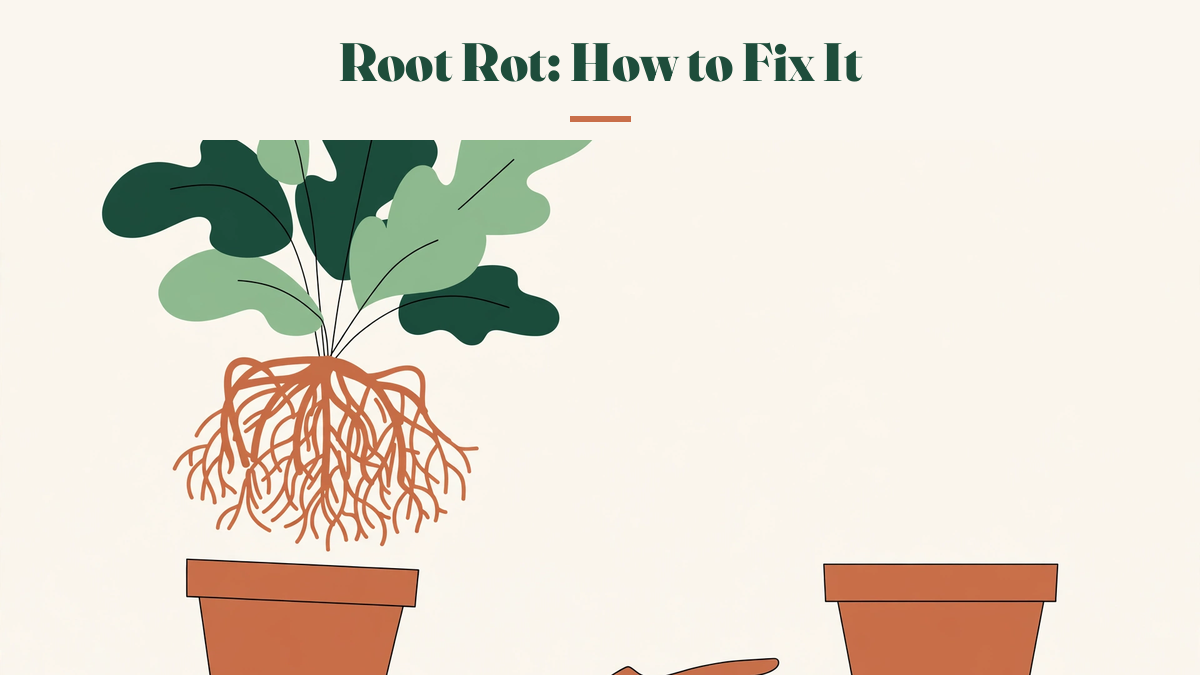
If the stem is soft at the base, or the plant pulls out of the soil with almost no roots attached, the main plant may not survive. But all is not necessarily lost. If there's any healthy stem growth above the rot, take cuttings: cut a healthy stem section, remove the lower leaves, and root it in water or moist soil. Many houseplants — pothos, philodendron, monstera, tradescantia — root readily from cuttings, and a cutting from a dying plant is a fresh start. The full root-rot rescue, including when to give up on the main plant, is in my guide to how to fix root rot.
The recovery log: what to expect
Recovery from overwatering is slow, and the slowness is what makes people panic and intervene again. This is the timeline I observed when I rescued the peace lily from my intro — it had moderate root damage, about a third of its roots trimmed away, and was repotted into fresh mix. Your plant's timeline will vary, but the shape of it — slow start, then steady improvement — is typical.
| Time | What I saw | What I did |
|---|---|---|
| Day 1 | Repotted, trimmed roots, watered lightly | Put it in bright indirect light, away from the radiator |
| Day 3 | Still drooping; one more leaf yellowed | Nothing. Resisted watering. |
| Day 7 | Drooping eased slightly; soil still damp halfway down | Nothing. Checked the soil with a skewer. |
| Day 10 | First sign of firmness returning to the leaves | Watered lightly — the first water since repotting |
| Day 14 | No new yellow leaves; the plant looked stable | Removed the last yellow leaf |
| Day 21 | A new leaf starting to unfurl from the centre | Resumed normal watering, by soil feel |
| Day 35 | Two new leaves, plant looked like itself | Fed at half strength for the first time |
| Day 60 | Fully recovered; flowering again | Normal care |
The hardest part was days 3–7, when the plant still looked terrible and every instinct said to do something. Doing nothing was the treatment. If your plant is on a similar path, the thing to watch is not the old leaves — they're not coming back — but the centre of the plant, where new growth emerges. A new leaf is the plant telling you the roots are working again.
Prevention: making overwatering hard to do
The best rescue is the one you never need. Overwatering is a systems problem — it's not about willpower, it's about setup. These four changes make it genuinely difficult to overwater, even if you're generous with the watering can.
Use pots with drainage holes. This is the single most important change. A pot without drainage is a pot that can never fully drain, and the water pooling at the bottom is where rot starts. If you love a decorative pot without holes, use it as a cover pot: keep the plant in a plastic nursery pot inside it, and tip the excess water out of the cover pot after watering. My guide to drainage holes covers the workarounds in detail.
Use an airy soil mix. Standard potting soil holds a lot of water. Mixing in perlite, bark chips, or coarse sand creates air pockets that drain freely and let oxygen reach the roots. I use roughly one part perlite to two parts potting soil for most of my plants, and more perlite for succulents and anything rot-prone.
Water by feel, not by calendar. A plant's water needs change with the season, the light, the temperature, and its growth rate. A schedule that works in July drowns the same plant in January. Check the soil before every watering — finger test, skewer test, or lift test — and only water when the soil tells you to. The full method is in my guide to how to water houseplants.
Match the pot to the plant. A small plant in a large pot sits in a volume of soil its roots can't use, and that soil stays wet. Repot up gradually — one pot size at a time — and only when the plant has genuinely outgrown its current pot. A snug pot dries faster and is far more forgiving of an extra watering.
One more thing I've learned: keep a simple watering log, even a mental one. "Watered the monstera on Sunday" is enough. The most common overwatering scenario isn't one big soak — it's two people in a household each watering the same plant, or watering on Tuesday because you forgot you watered on Sunday. A quick note prevents that entirely.
If your plant is drooping and you're not sure whether it's water or something else, my guide to why your houseplant is drooping walks through the full differential — underwatering, overwatering, and shock each leave different clues.
Frequently asked questions
How do I know if my plant is overwatered?
The defining sign is wilting while the soil is still wet. Other signs: yellowing leaves, a heavy pot, soil that stays soggy for days, fungus gnats, and a sour smell from the pot.
Can an overwatered plant recover?
Yes, if the roots are still mostly healthy. Stop watering, let the soil dry out, and improve drainage. If the roots are brown and mushy, trim the rot and repot into fresh mix.
Should I repot an overwatered plant?
Only if the roots are rotting or the soil won't dry. For mild overwatering, drying out in place is less stressful than repotting. Check the roots before deciding.
How long does it take an overwatered plant to dry out?
Usually 1–2 weeks for the soil to dry through, depending on pot size, soil mix, and season. A plant in a small pot with airy mix dries faster than one in a large pot of dense soil.
What's the difference between overwatered and underwatered?
Both wilt and yellow, but the soil tells them apart: overwatered soil is wet and the pot is heavy; underwatered soil is dry, light, and may pull away from the pot edge.
If you remember one thing… a drooping plant in wet soil is drowning, not thirsty — check the soil before you reach for the watering can, and let the roots breathe.