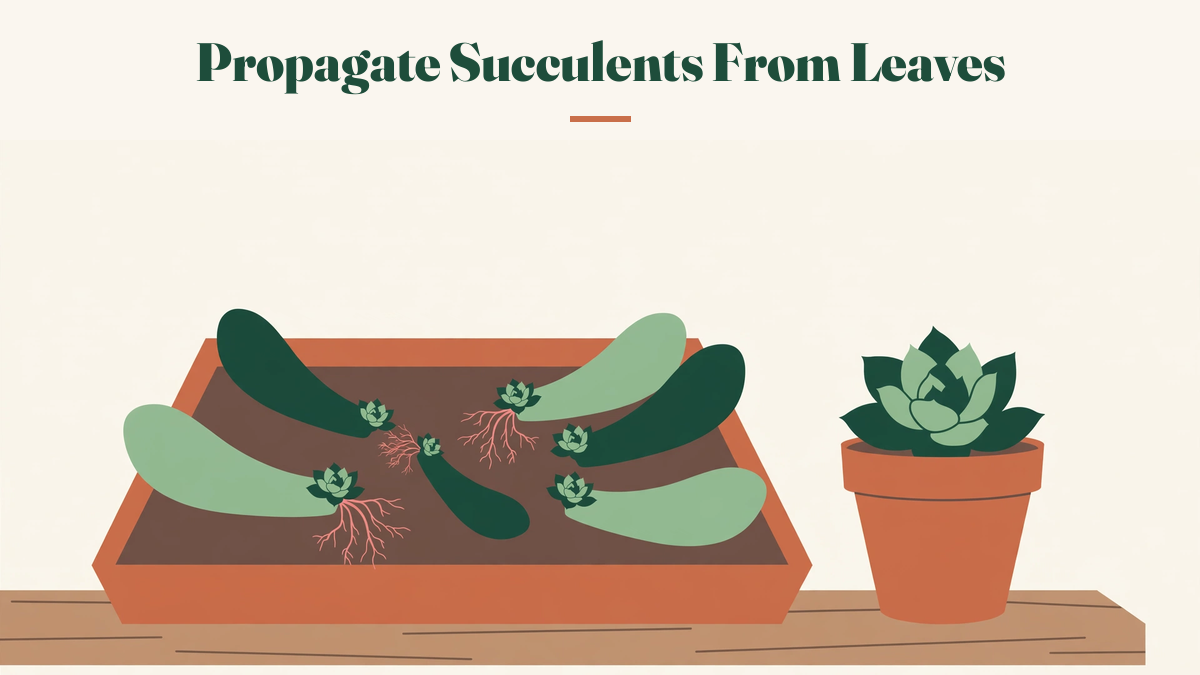
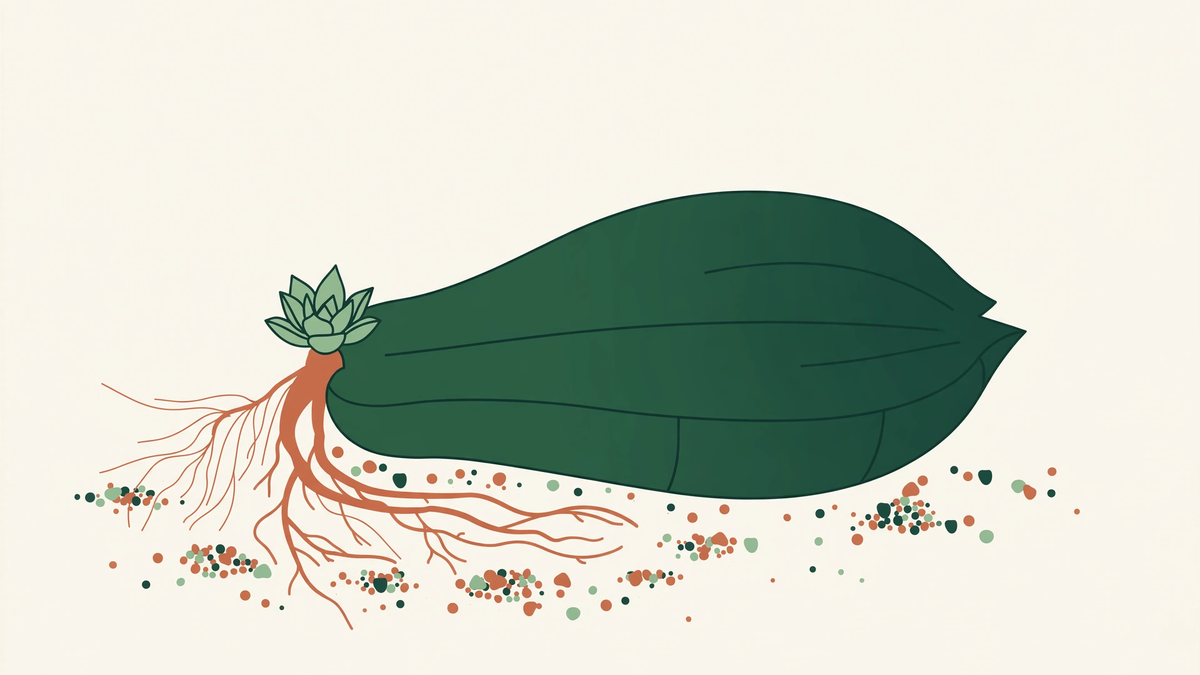
A plump echeveria leaf fell off behind a shelf, and I found it weeks later with a cluster of pink roots and a tiny rosette already forming at its base — no soil, no water, no attention at all. It had done the whole thing on a dusty shelf, using nothing but the water stored inside its own leaf.
That is the wonderful and slightly humbling thing about leaf propagation: the leaf already knows how to do this. Your job is mostly to stay out of the way, provide a decent surface, and resist the urge to help by watering it. Most leaf-propagation failures come from too much care, not too little.
This guide covers the full method — picking and pulling leaves, the callous, the tray, the long wait, and potting up — plus an honest account of what the success rate actually looks like when you propagate a whole batch at once.
Why a single leaf can become a whole plant
A succulent leaf is not just a leaf. It is a storage organ, packed with water and nutrients, and at its base — the point where it joined the stem — sits a cluster of meristem cells. Meristem is the plant world's stem-cell tissue: undifferentiated cells that can become roots, stems, or leaves depending on what the plant needs. When a healthy leaf is separated from the mother plant, those cells wake up and start building a new plant, powered by the water and food stored in the leaf itself.
This is why the leaf needs to come off cleanly. If the base tears, the meristem is damaged or left behind on the stem, and the leaf can only dry up. If the base is intact, the leaf carries everything it needs: the blueprint, the building material, and the fuel. It does not need you to feed it, water it, or encourage it. It needs a dry surface, some light, and time.
It also explains why leaf propagation works best with plump, healthy leaves. A thin, wrinkled, or yellowing leaf has little stored water left — it may root, but the baby it produces will be weak, and the leaf may shrivel before the baby can support itself. Always propagate from the best leaves, not the sad ones you were going to throw away anyway.
Which succulents work — and which don't
Most rosette-forming succulents propagate from leaves readily. Echeveria is the classic — nearly every species roots easily, and some will produce two or three babies from a single leaf. Graptoveria and sedum are similarly reliable. Jade plants (crassula) root from leaves too, though more slowly. I have had good results with all of these, and they are the ones I recommend starting with.
Some succulents rarely or never root from a leaf, and it is worth knowing which before you strip a plant for nothing:
- Aloe vera: leaves almost never root. Aloe propagates by offsets — the pups that appear around the base. See aloe vera indoors for how to separate them.
- Haworthia: leaf propagation is possible but slow and unreliable; offsets are far easier.
- Cacti: most cacti have no leaves to propagate from at all, and propagate from pads or offsets instead.
- String of pearls and other trailing succulents: leaf propagation is poor; stem cuttings are the way to go.
If you are unsure about a particular plant, try three or four leaves rather than stripping the whole plant. A small test batch tells you everything you need to know without risking the mother plant.
Picking and pulling the leaf
Choose leaves from the lower or middle part of the rosette — mature, plump, fully coloured leaves. The outermost leaves are often the oldest and may already be on their way out; the tiny centre leaves are too young and too small. The sweet spot is a firm, full leaf about two-thirds of the way out from the centre.
The pull is the make-or-break moment. Hold the leaf near its base, between thumb and forefinger, and wiggle it gently side to side while pulling outward and slightly downward. You are aiming for a clean snap at the base — the whole leaf should come away with a smooth, rounded end. If you hear a small snap and the base looks clean, you have done it. If the leaf tears and leaves a chunk behind on the stem, or if the base looks ragged and wet, that leaf is unlikely to propagate. Discard it and try another.
A few practical notes from experience:
- Propagate in spring or early summer if you can. Leaves pulled in the growing season root faster and produce stronger babies. Winter leaves will still root, but everything takes longer.
- Do not water the mother plant the day before. A slightly thirsty succulent gives up its leaves more easily, and the leaves are less likely to tear.
- Take more leaves than you need. Not every leaf will make it, even with perfect technique. I plan on roughly three-quarters succeeding, and I take a few extra for insurance.
The callous: the step everyone skips
Once you have your leaves, lay them on a dry surface — a plate, a tray, a sheet of paper — somewhere with bright indirect light and good air circulation. Leave them alone for three to five days. During this time the broken base dries over and forms a callous, a thin, dry seal over the wound.
This step is the difference between roots and rot. A fresh, wet leaf base placed on damp soil will absorb moisture through the wound and rot from the inside out. A calloused base is sealed, and roots emerge from behind the seal when the leaf is ready. I know it feels like doing nothing — because it is doing nothing — but it is the most important nothing in the whole process.
You will know the callous has formed when the base looks dry and slightly shrivelled, with a thin papery skin over the break. In a dry room this takes two or three days; in a humid room it can take a week. If you are unsure, wait another day. A leaf can sit callousing for two weeks without harm; a leaf put on wet soil too early can rot in days.
Setting up the tray
You do not need special equipment. A shallow tray, a seed tray, or even a takeaway container with holes punched in the bottom will do. Fill it with a light, gritty mix — standard cactus and succulent soil works, or regular potting mix with a generous handful of perlite or coarse sand mixed in. The mix should feel loose and free-draining, not dense.
Lay the calloused leaves on top of the soil. Do not bury them, do not push them in, do not stand them upright. Just lay them flat, base end touching the soil, spaced a centimetre or two apart so air can circulate between them. That is the whole setup. No dome, no cling film, no humidity tent — succulent leaves want dry air, not a greenhouse.
Place the tray in bright, indirect light. A south-facing windowsill with a sheer curtain is ideal; a spot that gets a couple of hours of gentle morning sun is fine too. Harsh midday sun through glass will scorch the leaves, especially once the delicate baby rosettes appear, so avoid the hottest spot in the house. For more on getting light right indoors, see how much light indoor plants really need.
The long wait: a week-by-week log
Leaf propagation is slow, and the honest timeline is longer than most guides admit. Here is what actually happened with a batch of twelve echeveria leaves I propagated one spring, tracked from the day I pulled them:
| Week | What I saw | Notes |
|---|---|---|
| 1 | Leaves callousing on a plate | No water, no soil yet |
| 2 | Leaves laid on the tray | Bases dry and sealed; nothing else happening |
| 3 | Pink root threads on 5 of 12 leaves | Roots appear before babies; the first roots are hair-thin and pink |
| 4 | Roots on 9 of 12; tiny rosettes on 3 | The fastest leaves had both roots and a baby the size of a pea |
| 6 | Rosettes on 8 of 12; 2 leaves shrivelling with no roots | The two failures were the thinnest leaves in the batch |
| 8 | 9 babies growing; mother leaves starting to wrinkle | The babies were now feeding on the mother leaf's stored water |
| 12 | Mother leaves mostly dried up; 9 independent baby plants | Babies 2–3 cm across, ready to pot up individually |
Final tally: 9 out of 12 leaves became plants — a 75% success rate from healthy leaves with good technique. The three failures were two thin leaves that shrivelled before rooting and one that went mushy (it had a slightly torn base I should have rejected). That ratio is typical in my experience: expect most leaves to make it, and expect a few to fail no matter what you do.
Watering: less than you think, later than you think
The watering rule I follow for leaf propagation is simple: I don't water until I see roots. Before roots appear, the leaf has no way to take up water, and wet soil just invites rot. The leaf is feeding the baby from its own reserves, and it does not need your help.
Once roots are visible, start misting the soil lightly around the roots — not the leaves themselves — every few days, just enough to dampen the top of the mix. I use a small spray bottle and give each rooted leaf two or three spritzes at the base. The soil should dry out between mistings. If the tray stays damp for days, you are misting too much or too often, and the mother leaves will start to go soft.
As the babies grow and the mother leaf shrivels, you can water a little more generously, but the same principle holds: succulents want a wet-dry cycle, not constant moisture. When in doubt, wait a day. A dry baby will perk up with a drink; a rotted baby will not come back.
When the mother leaf dies (and when to pot up)
At some point — usually around week eight to twelve — the mother leaf will wrinkle, dry up, and fall away from the baby. This is supposed to happen. The mother leaf has done its job: it fed the baby until the baby had roots of its own. Do not pull it off early. Let it dry naturally and drop off, or remove it gently once it is completely crisp and papery. A mother leaf that is still plump is still feeding the baby.
Pot the babies up individually when they are 2–3 cm across with a visible root system, or when they start crowding each other in the tray. Use small pots — 5–7 cm is plenty — with the same gritty mix, and water them in lightly. From here on, they are simply young succulents, and they follow the same care as any small succulent: bright light, infrequent watering, and a pot that is not too big.
Do not expect a full-sized plant quickly. A leaf-grown echeveria takes a year or more to reach the size of a shop-bought plant. That is the trade-off: leaf propagation is nearly free and deeply satisfying, but it is not fast. If you want a big plant now, buy one. If you want a dozen plants for the cost of a tray of soil, grow them from leaves.
Troubleshooting: what goes wrong
The leaf turns translucent and mushy. This is rot, almost always from water getting into an uncalloused wound or from a tray that stayed wet. Remove the leaf before it affects its neighbours. Next time, callous longer and keep the tray drier.
The leaf shrivels up with no roots. The leaf was probably too thin or too old, or the air was very dry and the leaf lost its stored water before the meristem woke up. Try plumper leaves, and make sure you are propagating in the growing season.
Roots grow but no baby appears. This is the most frustrating outcome: a leaf with a healthy root system and no rosette. Sometimes the baby just needs more time — I have had leaves root in week three and produce a baby in week ten. Sometimes it never comes. Leave it in the tray; it costs you nothing, and a surprising number of them eventually produce a rosette.
The baby grows tall and pale. This is etiolation — the baby is stretching for light. Move the tray to a brighter spot. A leggy baby will not shrink back, but new growth will come in compact if the light improves.
White mould on the soil surface. Usually harmless saprophytic mould feeding on organic matter in the mix, but it is a sign the tray is too damp. Let the soil dry out, improve air circulation, and scrape off the mouldy top layer if it bothers you.
Frequently asked questions
How long does it take to propagate succulents from leaves?
Roots usually appear in 2–4 weeks, and a visible baby rosette in 4–8 weeks. A leaf-grown succulent takes 3–6 months to become a small plant you can pot up on its own.
Do succulent leaves need water while they root?
Not at first — the leaf feeds the baby from its own stored water. Once roots appear, mist the soil around the roots lightly every few days. Never soak the tray.
Why do my succulent leaves turn mushy and die?
Usually too much water too soon, or a leaf that was damaged when it was pulled off. A torn base can't callous properly, and moisture gets in and rots the leaf from the inside.
Can you propagate any succulent from a leaf?
Most rosette succulents (echeveria, graptoveria, sedum) propagate readily from leaves. Some, like aloe and haworthia, rarely root from leaves — they are better propagated by offsets.
Should you bury succulent leaves or lay them on top of the soil?
Lay them on top. Burying a leaf traps moisture against it and causes rot. Roots grow down into the soil on their own once they appear.
Leaf propagation is the slowest way to get a new succulent, and also the most generous — one plant can become a dozen. If you want to compare how the rooting medium changes the outcome for cuttings of all kinds, see water vs soil vs sphagnum moss, and jade plant care covers the long-term care of one of the best leaf-propagated succulents of all.
If you remember one thing… — a clean snap, a proper callous, and no water until you see roots: that is the whole method.