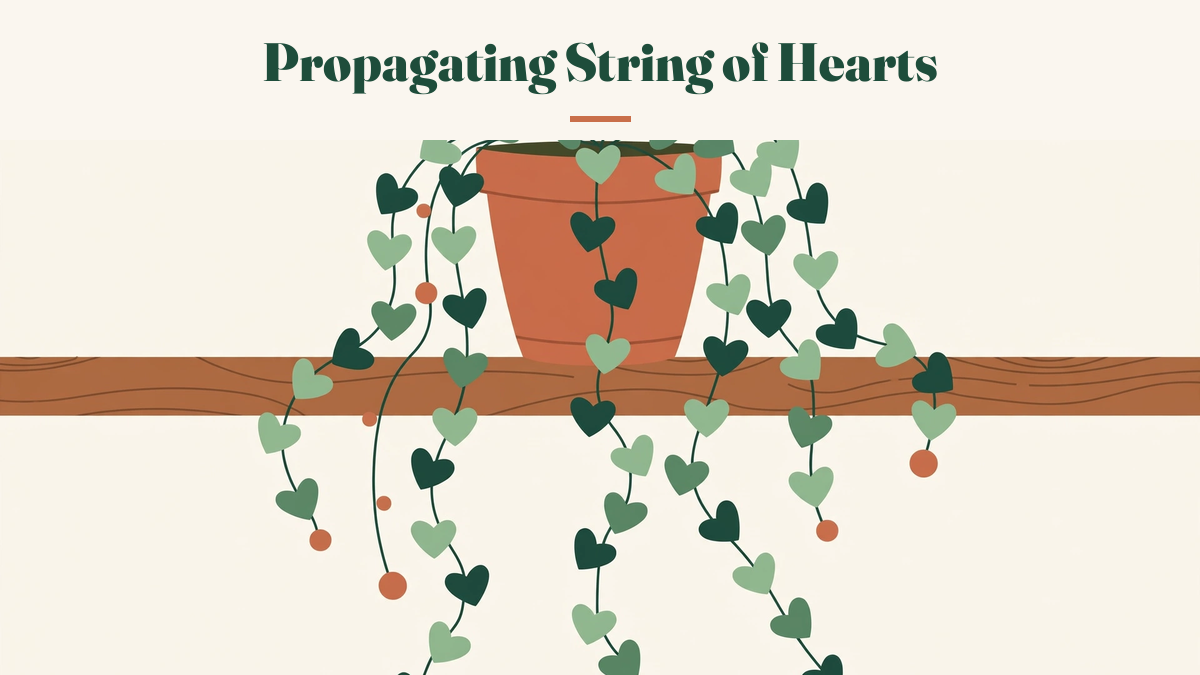
String of hearts is the plant that made me feel like a good propagator, and I owe it an apology for that, because the plant does nearly all the work. It throws out roots at every node, grows little potato-like tubers along its stems that are practically begging to become new plants, and roots from a cutting with the enthusiasm of a pothos. Where some plants make you earn every new leaf, string of hearts hands you four different propagation methods and lets you pick your favourite.
The result is that one healthy plant can become a shelf full of them within a year — and they make wonderful gifts, because a small pot of string of hearts looks far more established than its few months of age suggests. This guide covers all four methods, with an honest comparison of which ones are actually worth your time. I've tested them side by side, and the winner surprised me.
If you haven't grown the plant itself yet, it's worth knowing that string of hearts (Ceropegia woodii) is a trailing succulent native to southern Africa, from Zimbabwe to eastern South Africa. That succulent heritage matters for propagation: the stems and leaves store water, the plant hates sitting wet, and the cuttings want barely-damp soil rather than the soggy conditions that suit a monstera cutting. UW–Madison Extension puts it bluntly — the plant is easily killed by overwatering. Keep that in mind throughout: almost every failure with this plant comes from too much water.
The four methods at a glance
Before the detail, here's how the methods compare. The numbers in the table come from a batch I ran last spring: ten attempts at each method, all started the same weekend, all on the same shelf.
| Method | Difficulty | Time to roots | Success rate (my batch) | Best for |
|---|---|---|---|---|
| Butterfly cuttings | Easy | 2–4 weeks | 9 of 10 | Making lots of plants from one vine |
| Tuber cuttings | Easiest | 1–2 weeks | 10 of 10 | The fastest, most reliable new plant |
| Stem cuttings in water | Easy | 2 weeks | 8 of 10 | Watching roots grow; quick results |
| Layering (pinning a vine down) | Easiest | 3–4 weeks | 10 of 10 | Filling out a thin plant without cutting it |
The surprise for me was the tubers. I'd ignored them for years, treating them as a curiosity, when they're actually the fastest and most reliable method the plant offers. The butterfly method is the most satisfying — there's something delightful about a tray of little leaf-pairs all rooting at once — but if you want one new plant quickly and with zero fuss, a tuber is the answer.
Method 1: the butterfly method
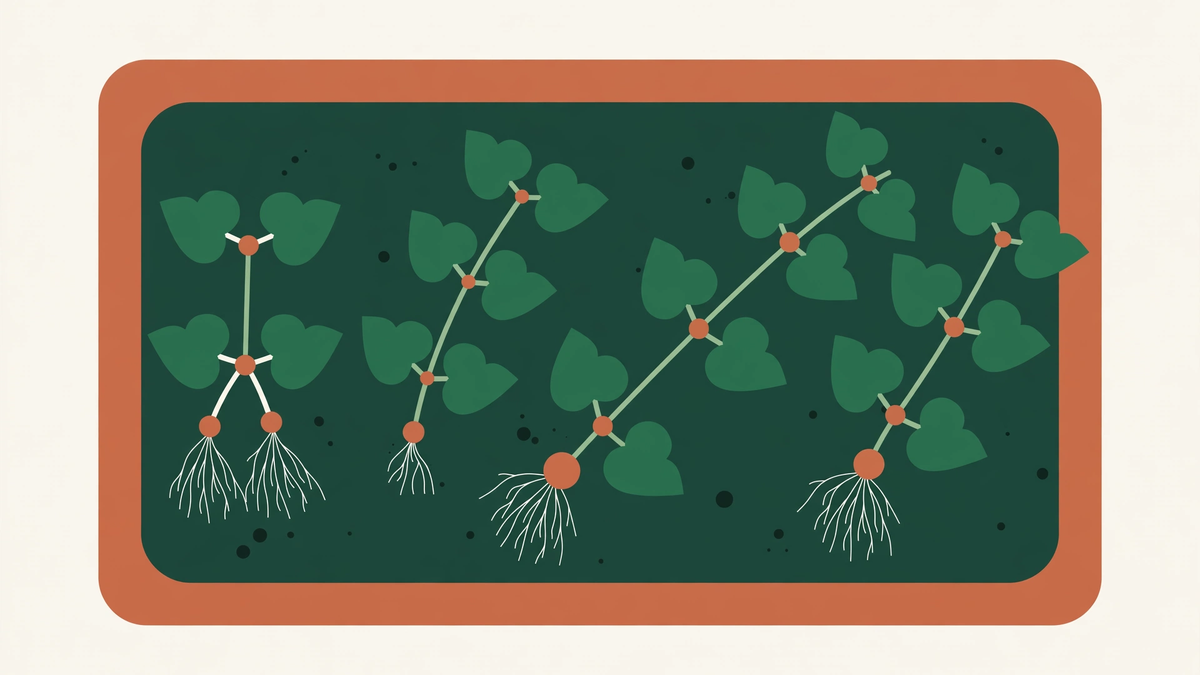
The butterfly method is the signature string of hearts technique, and it gets its name from the shape of the cutting: two opposite leaves with a short piece of stem between them, which looks — with a little imagination — like a butterfly with its wings spread.
Start by choosing a healthy vine and finding a leaf pair you like. Cut the stem about a centimetre on either side of the node (the point where the leaves attach), so you have a little stem section with two leaves and a node in the middle. A sharp pair of scissors or a clean blade gives a better result than tearing — ragged cuts rot more easily.
Lay the cuttings flat on the surface of barely-damp, well-draining mix — cactus or succulent mix is ideal, or ordinary houseplant compost with plenty of perlite. The node should be in contact with the soil; the leaves sit on top like a tiny tent. Don't bury the cutting. Press the node gently into the surface so it touches the mix, and leave it there.
Then — and this is the hard part — leave it alone. Mist the surface lightly every few days to keep the top layer of soil just damp, and keep the tray somewhere warm with bright indirect light. Roots will form at the node within two to four weeks, followed by a tiny tuber, and then new growth will push up from the node. You'll know it's worked when you see a small shoot appearing between the two original leaves.
A few practical notes from my batch of ten: the cuttings that rooted fastest were the ones I didn't cover with a humidity dome. String of hearts is a succulent, and a sealed, humid environment encourages rot faster than it encourages roots. An open tray in a room with normal humidity worked better than a bagged one. I also found that grouping the cuttings close together in one tray — a dozen butterflies in a 15 cm pot — worked better than individual pots, because the shared soil stays more evenly moist.
The one failure in my batch was a cutting I buried too deep. The leaves rotted at the soil line within a week. On the surface, not in the soil — that's the rule.
Method 2: tuber cuttings
If your string of hearts is mature enough, you'll notice small round balls — the size of a pea or a marble — forming along the stems, usually at the nodes. These are aerial tubers: storage organs packed with starch and water, each one containing everything a new plant needs to get started. In the wild, they drop off, roll away, and root where they land.
To propagate from a tuber, wait until it's at least pea-sized, then cut the stem about a centimetre on either side of it. Press the tuber halfway into barely-damp soil, stem pieces and all, and keep it in bright indirect light. That's the entire method. The tuber already contains stored energy, so it doesn't need to grow roots before it can grow — it just starts. In my batch, the first tuber cutting showed new growth in eleven days, and all ten succeeded.
Tubers are also the method to use if you want to fill out a thin or leggy plant. Rather than cutting the tuber off, pin the stem down onto the soil surface in the same pot — a bent paperclip or a hair grip works as a pin — with the tuber in contact with the mix. It will root in place and send up new vines from the same pot, making the plant fuller from the top rather than longer from the ends.
One caution: don't harvest every tuber from a plant. They're energy stores, and stripping them all weakens the mother plant. Take a few, leave the rest, and the plant will make more.
Method 3: stem cuttings in water
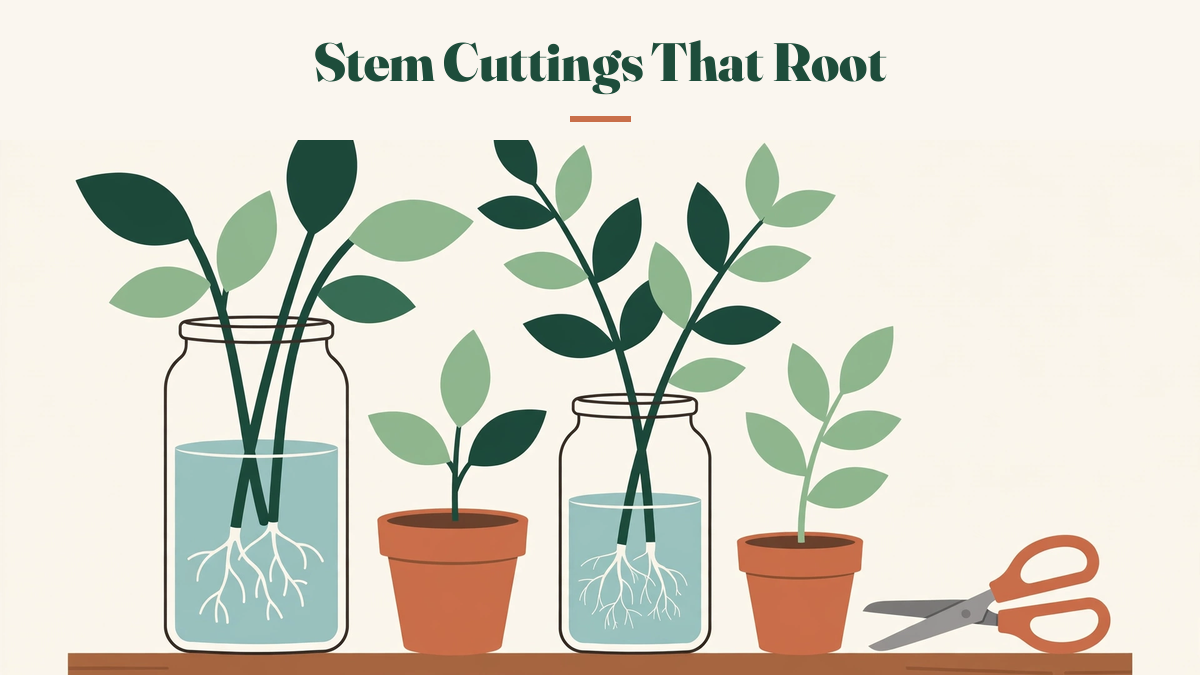
This is the familiar method — the one that works for pothos, philodendron, and most trailing plants — and it works fine for string of hearts too. Cut a length of vine, remove the lowest pair of leaves, and stand the cutting in a jar of water with at least one node submerged. Roots appear in about two weeks.
It's the most visually satisfying method, because you can watch the roots grow, but it's not my first choice for this plant, and the numbers show why: eight out of ten in my batch, with two cuttings rotting at the waterline. The stems are thin and succulent, and they rot more readily in standing water than a pothos stem does. Changing the water every few days helps, and keeping only the node (not the leaves) underwater is essential.
If you do root in water, move the cutting to soil as soon as the roots reach 3–5 cm. Water roots and soil roots are different structures, and the longer a cutting stays in water, the harder the transition. The full water-to-soil guide covers the move in detail — it's the step where most water-rooted cuttings are lost.
Water cuttings are best for a quick gift or for rescuing a vine that broke off. For a planned batch of new plants, the butterfly method or tubers give better odds with less fuss.
Method 4: layering (no cutting required)
Layering is the gentlest method of all, because you don't cut anything. Take a long vine, choose a node partway along it, and pin that node down onto the soil surface — either in the mother plant's own pot, or in a small pot of soil placed beside it. The node will root into the soil over three to four weeks while still attached to the mother plant, which keeps feeding it the whole time.
Once the node has rooted and started pushing new growth, you can cut the vine on the mother-plant side of the new root, and the layered section becomes an independent plant. Or you can leave it attached indefinitely, which is how you turn a thin, leggy plant into a full one: layer two or three vines back into the same pot, and within a couple of months the top of the pot is covered in new growth instead of bare stems.
This is the method I use when a plant has gone bald at the top — the classic string of hearts problem, where the vines are long and lovely but the pot itself looks empty. Rather than taking cuttings, I just wind a couple of vines around the soil surface and pin them down. It's the lowest-effort fix in all of houseplant care, and it works every time.
Aftercare: the first two months
However you propagate, the aftercare is the same, and it's where most losses happen. New string of hearts plants want:
- Bright indirect light. A few hours of gentle morning sun is fine; harsh afternoon sun through glass will scorch the thin leaves.
- Barely damp soil. Water only when the top 2 cm of mix is dry. A new plant in a small pot needs far less water than you think — a tablespoon at a time is often enough.
- Warmth. Room temperature is fine; avoid cold windowsills in winter, where the soil stays cold and wet.
- Patience. A butterfly cutting may sit looking unchanged for a month before it pushes new growth. If the leaves are still plump and green, it's alive and working underground. If the leaves go soft and translucent, it's rotting — remove it before the rot spreads to its neighbours.
Don't feed a new plant for at least two months. The fresh mix has enough nutrients, and fertiliser on unestablished roots does more harm than good. When the new plant has put out several inches of vine, you can start feeding at half strength during the growing season.
The most common aftercare mistake is repotting too soon. A new string of hearts is happy in a tiny pot for months — it likes being snug, and a pot that's too big holds too much wet soil around a small root system. Wait until the plant has filled its pot with roots before moving it up.
What happens to the mother plant
Taking cuttings from a string of hearts is, in most cases, good for the mother plant rather than harmful. Cutting a vine back encourages it to branch — a new shoot usually emerges from the node just below the cut within a few weeks, so one vine becomes two. A plant that gets a light trim every spring ends up bushier and fuller than one left to trail untouched.
There are two limits worth respecting. First, don't take more than about a third of the plant's vines in one session. String of hearts is generous, but a heavy harvest leaves the mother plant with too little foliage to feed its root system, and it will sulk. Second, always cut just above a node, leaving a short stub of stem. Cutting mid-stem between nodes leaves a bare end that dries back and looks untidy; cutting just above a node gives the plant a clean point to branch from.
If you took tubers, the mother plant will replace them. New tubers form at nodes through the growing season, usually appearing on vines that are a year or more old. I've noticed they form more readily on vines that get good light — the tubers are storage organs, and a plant in bright light has more surplus energy to store. So if your plant has no tubers yet, a brighter spot (still indirect) is the likeliest fix.
Which method should you choose?
It depends on what you want. For a single new plant, fast: take a tuber. For a batch of plants to share: butterfly cuttings — a single long vine can give you eight or ten. For a quick rescue of a broken vine: water. For filling out a leggy plant without cutting anything: layering.
And if you want to make a full, lush pot from scratch, combine methods: plant five or six butterfly cuttings and a couple of tubers in the same small pot. They'll root at slightly different speeds, but within three months you'll have a pot that looks like a plant several years old rather than a single vine trailing from a tiny pot.
String of hearts pairs naturally with other trailing plants on a high shelf — the hanging plants guide has the full list — and if you enjoy the butterfly method, succulent leaf propagation uses a similar lay-it-on-soil approach with a very different family of plants.
Frequently asked questions
What is the butterfly method for string of hearts?
You cut a pair of leaves with a short piece of stem — shaped like a butterfly — and lay it flat on moist soil. Roots and a new tuber form at the node within a few weeks.
How long does string of hearts take to propagate?
Butterfly cuttings root in 2–4 weeks and show new growth in 6–8 weeks. Tuber cuttings are faster — often growing within 2–3 weeks. Stem cuttings in water root in about 2 weeks.
Can you propagate string of hearts in water?
Yes. Stem cuttings with a node root readily in water, usually within two weeks. Move them to soil once the roots are 3–5 cm long.
What are the round balls on my string of hearts?
They're aerial tubers — small potato-like storage organs that form along the stems. Each one can grow into a new plant, and they're the fastest propagation method of all.
Why are my string of hearts cuttings rotting?
Almost always too much moisture. The soil should be barely damp, not wet, and butterfly cuttings should sit on the surface rather than being buried.
If you remember one thing… the tubers are the fastest route to a new plant, the butterflies are the most fun — and with both, barely-damp soil beats wet soil every time.