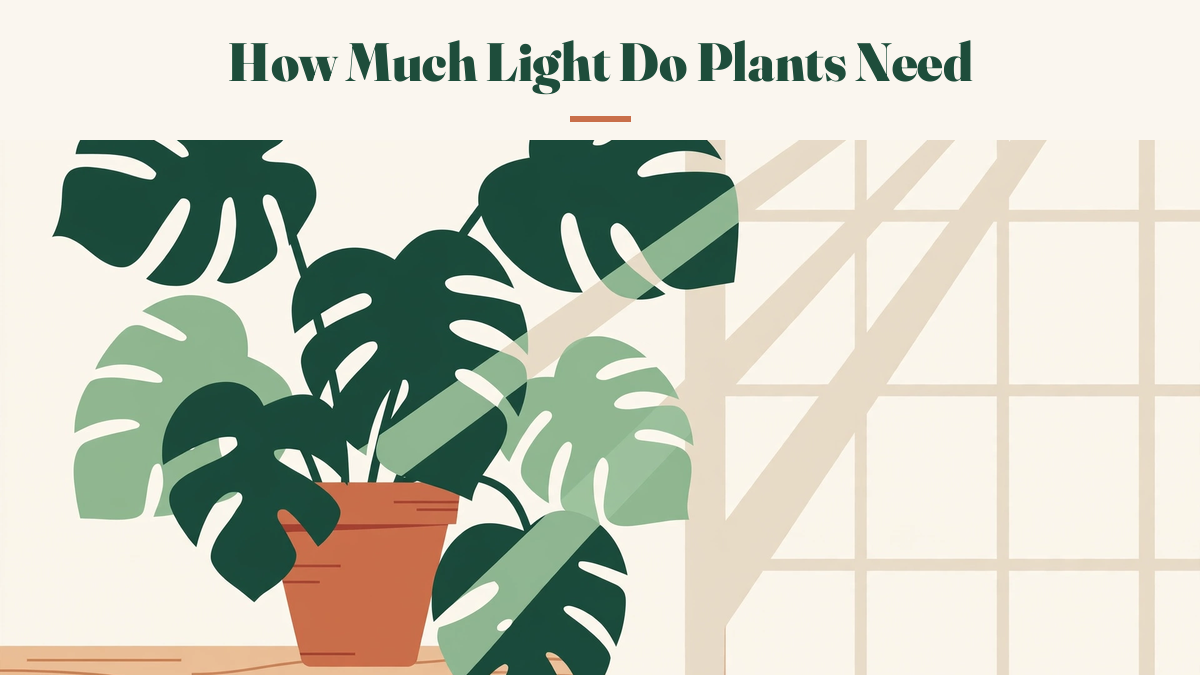
The plant that taught me about light was a pothos sitting on top of a bookcase, about three metres from my brightest window. It looked fine. It was green, it was alive, and for two years I told myself it was doing well. Then I moved it to a shelf beside the window — same pot, same soil, same watering — and within two months it had put out more growth than in the previous year. The leaves were bigger, the variegation came back, and it started trailing properly instead of producing one sad vine.
Nothing else had changed. Just light. Light is the single most important factor in whether a houseplant thrives, and the one most of us judge worst. Our eyes adjust brilliantly — a room that looks "bright" to us can be a cave to a plant, because our pupils dilate and our brains compensate. The plant has no such trick — it gets exactly the photons that reach it.
Why "bright indirect light" is useless advice (until you decode it)
Almost every plant label says "bright indirect light," and almost nobody explains it. It sounds precise. It isn't — three vague words stacked together, leaving beginners to guess.
Here's the decoding I wish someone had given me:
- Bright refers to intensity — how much light is arriving. A bright spot is one where you could comfortably read a book all day without a lamp, and where the room feels sunlit even on a cloudy morning.
- Indirect refers to the sunbeams. Indirect light means no direct rays falling on the leaves. The light is bounced, filtered through a sheer curtain, or coming from a window the sun never shines straight through.
- Light means daylight, not lamplight. A ceiling light three metres above a plant contributes almost nothing. Plants run on sunlight — or on a proper grow light, which is a different conversation.
Put together, "bright indirect light" means: a spot near a window, getting lots of daylight, but never sitting in a sunbeam. In most homes, that is within a metre or two of an east- or west-facing window, or a couple of metres back from a south-facing window, or right beside a north-facing one.
The other common terms decode the same way. "Low light" does not mean no light — it means a spot that still gets daylight, just not much of it: a north-facing room, a spot several metres from a window, a hallway with a skylight. "Direct sun" means sunbeams landing on the leaves for part of the day. "Full sun" means six or more hours of it, which almost no houseplant wants indoors.
The three light levels, translated
I keep coming back to a simple table whenever I'm deciding where a new plant goes. It is based on distance from the window and what the light actually feels like, not on jargon. Distances assume an unobstructed window — a tree outside or a neighbouring building changes everything, and I'll get to that.
| Light level | Where it is | Hand-shadow test | Who likes it |
|---|---|---|---|
| Bright indirect | Within 1 m of an east/west window; 1–2 m from a south window | Sharp, dark shadow with clear edges | Monstera, fiddle-leaf fig, calathea, most tropicals |
| Medium | 1–2 m from an east/west window; beside a north window | Soft shadow, edges fuzzy but visible | Pothos, philodendron, spider plant, peace lily |
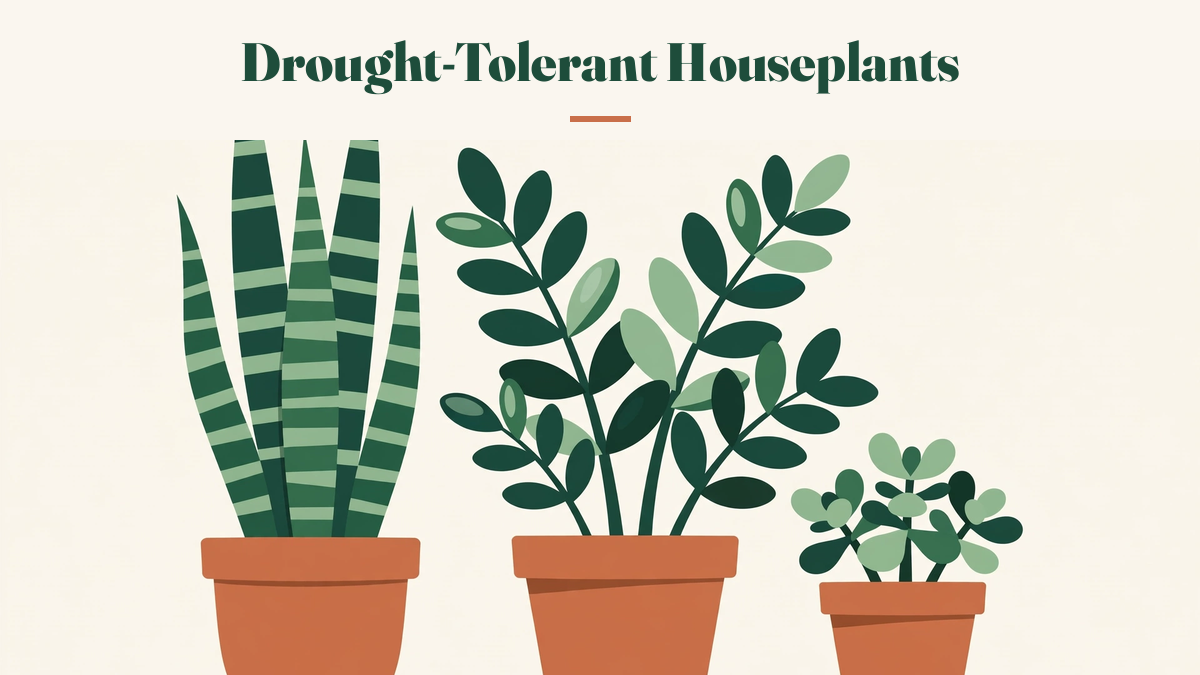
| Low | 2–3 m from any window; north-facing room; hallway with daylight | Faint shadow, or barely any shadow at all | Snake plant, ZZ plant, Chinese evergreen, cast iron plant |
The hand-shadow test is the fastest tool I know. Hold your hand about 30 cm above a sheet of white paper in the spot you're considering, at midday. A sharp, dark shadow with crisp edges means bright light. A soft, fuzzy-edged shadow means medium. A shadow so faint you can barely see it means low light. It takes five seconds, costs nothing, and it is far more honest than your eyes.
One warning: test at midday and test in winter too. A spot that is bright in June can be dim in December. I move several plants closer to windows every autumn and back again in spring — ten minutes twice a year, and the difference between a plant that sulks through winter and one that keeps growing.
Reading your windows
Not all windows are equal, and the direction yours face matters more than almost anything else. This is the part of light advice that is genuinely worth learning once and keeping forever. (I'm describing northern-hemisphere windows here — if you're south of the equator, swap north and south.)
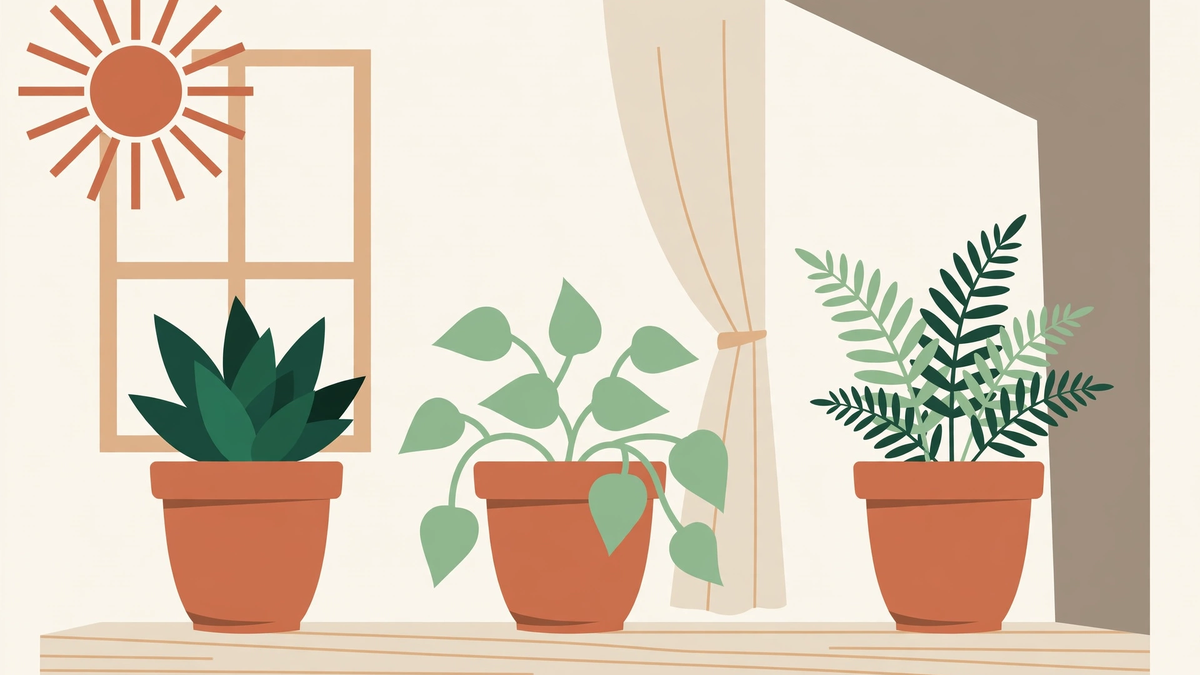
South-facing windows get the most light and the most direct sun — strong beams for much of the day. They are the best windows in the house for light-hungry plants, but the sill itself is too fierce for most tropicals in summer. The sweet spot is usually 1–2 metres back from the glass, or on the sill behind a sheer curtain. Succulents, cacti, and jade plants are the exceptions — they genuinely enjoy the sill.
East-facing windows are my favourite. They get gentle morning sun — direct rays for a few hours, but the morning sun is weaker and cooler than afternoon sun — then bright indirect light for the rest of the day. Almost every houseplant is happy near an east window, including the fussy ones. If you have one, put your best plants there.
West-facing windows get afternoon sun, which is hotter and harsher than morning sun. They are good for plants that want brightness, but the sill can scorch delicate leaves in summer. A metre back, or a sheer curtain, solves it.
North-facing windows never get direct sun. The light is soft, steady, and dim — the weakest of the four. Low-light plants do well here, and so do plants that scorch easily, but most plants will grow slowly beside a north window. It is the only direction where you can put a plant right on the sill without worrying about sunburn.
Then there are the modifiers that no label ever mentions: a tree outside the window, a balcony above it, a building across the street, dirty glass, net curtains. Any one of these can drop a "bright" window down a full level. My east window has a large tree outside it, and in summer, when the tree is in full leaf, the light there drops to something closer to medium.
How much light plants actually use
Here's a fact that changed how I think about placement: light intensity falls off fast with distance from the source — roughly following the inverse-square rule, so a plant sitting 2 metres from a window gets around a quarter of the light it would get at 1 metre. University of Missouri Extension puts a practical limit on it: even low-light plants usually don't get enough light more than 10 feet (about 3 metres) from an average window. This is why "near a window" and "in the same room as a window" are completely different things. The corner of the room that looks bright to you is, to the plant, deep shade.
This is also why so many plants end up in the same sad state: alive, green, and barely growing, year after year. They are not dying. They are starving, slowly, in a spot that looks fine to human eyes. My bookcase pothos was exactly this — it survived for two years on a fraction of the light it wanted, and I never noticed.
If you want a number rather than a feeling, light-meter apps on your phone will give you one. They measure in lux, and while they're not laboratory-accurate, they are good enough to compare spots in your home. Clemson Extension's indoor-plant guide puts low-light plants at roughly 75–200 foot-candles (about 800–2,000 lux), medium-light plants at 200–500 foot-candles, and high-light plants at 500–1,000 foot-candles. Other extension sources draw the lines differently — Missouri Extension's bands run higher — so treat any number as a rough guide, not a rule. For a sense of the scale: my phone app read over 10,000 lux on my south-facing sill on a sunny day, and barely 200 in the middle of my north-facing room. Measuring a few spots once, with a free app, will teach you more about your home's light than any amount of reading.
Signs your plant wants more light
Plants tell you about light problems, but they tell you slowly, and the signs are easy to misread. Here is what I look for:
- Leggy, stretched growth. Long gaps between leaves on a stem, with the plant reaching toward the window. This is the classic low-light signal — the plant is spending its energy trying to get closer to the light instead of growing properly.
- Small new leaves. Each new leaf comes out smaller than the last. The plant doesn't have the energy to build full-size leaves.
- Fading variegation. A variegated pothos or philodendron slowly goes all-green. The plant is maximising its green, light-catching surface because light is scarce.
- Leaning. All plants lean toward light a little, but a dramatic lean — a stem bent sideways at 45 degrees — means the light is too far away or too one-sided.
- No growth at all. A healthy plant in growing season that puts out nothing for months is usually short of light, assuming water and soil are fine. Growth is the plant's report card, and light is the biggest input.
- Soil that stays wet. This one surprises people. A plant in low light uses less water, so the soil stays damp longer. If you're watering correctly and the soil never seems to dry, the problem might be light, not water.
The fix is almost always the same: move the plant closer to a window, or to a brighter window. Do it gradually — a sudden move from a dim corner to a bright sill can scorch leaves that have adapted to low light. I move plants in stages over a week or two: closer to the window, then closer again, then into their final spot.
Signs of too much light
Too much light is less common indoors, but it happens, usually on south- or west-facing sills in summer. The signs are different from low-light problems and easier to spot once you know them:
- Scorch marks. Dry, bleached, or brown patches on the leaves, usually on the side facing the window. These look like sunburn because that is what they are — the leaf tissue has been damaged by intense direct sun.
- Faded, washed-out leaves. The whole leaf loses colour, going pale or yellowish, especially on the sun-facing side.
- Crispy leaf edges on plants that are otherwise watered correctly. (Brown tips have other causes too — water quality and fertiliser are the usual suspects — but if the damage is only on the window side, light is the likely culprit.)
- Leaves curling inward during the hottest part of the day, as the plant tries to reduce its exposed surface.
The fix is the opposite of the low-light fix: move the plant back from the window, or hang a sheer curtain to filter the sun. A sheer curtain is one of the best plant-care purchases I ever made — it turns a harsh south-facing sill into perfect bright indirect light for about the price of a takeaway.
Matching plants to the light you actually have
This is the part that saves you money. Instead of buying a plant and hoping your home suits it, work the other way round: figure out what light you have, then buy plants that want it. A plant matched to its spot needs less fussing, grows faster, and forgives your other mistakes more easily.
If your home is mostly low light — north-facing windows, a ground floor with buildings opposite, small windows — lean into the plants that genuinely thrive in it: snake plants, ZZ plants, Chinese evergreen, pothos, and peace lilies. These are not consolation prizes; they are some of the most attractive and forgiving houseplants there are.
If you have one bright window and a lot of medium light, put your light-hungry plants — monstera, fiddle-leaf fig, calathea — at the bright window, and fill the rest of the home with the medium-light crowd. And if you have a sunny south-facing sill, that is where succulents and cacti earn their keep.
One more practical habit: rotate your plants a quarter-turn every couple of weeks. Plants grow toward light, so a plant that never moves will lean and grow lopsided. A small rotation keeps growth even and — just as importantly — forces you to look at the plant from all sides, which is how you catch problems early. I do it when I water, so it costs no extra time at all.
What about grow lights?
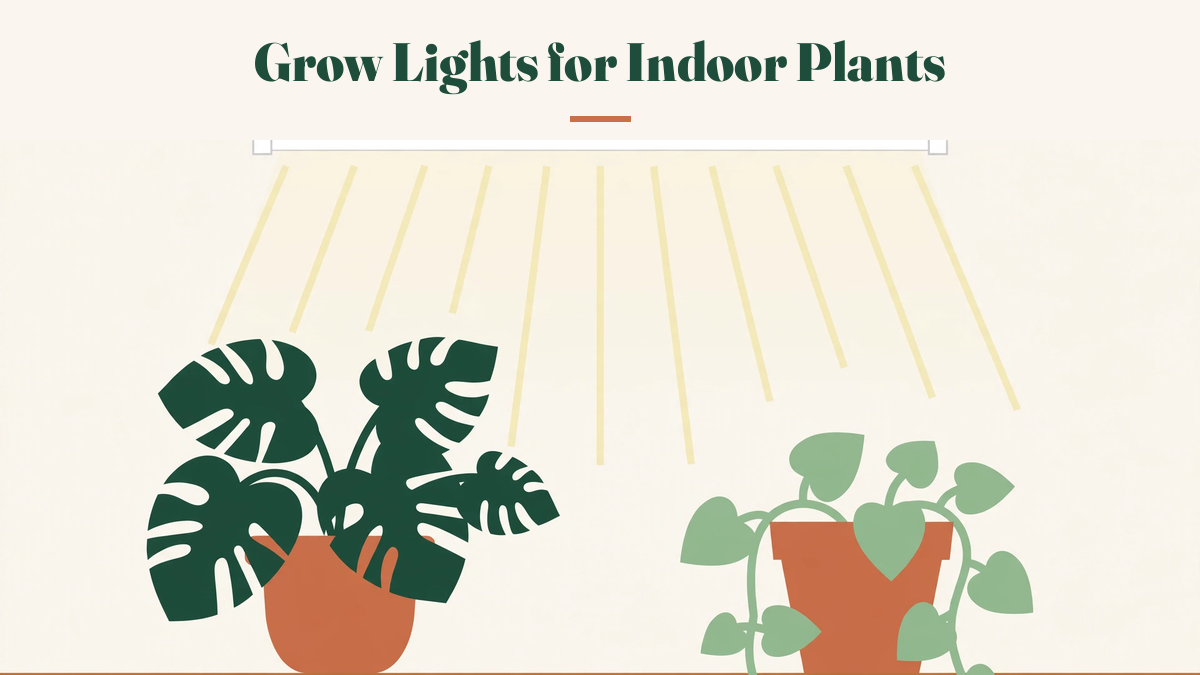
If your home genuinely doesn't have enough natural light — a basement flat, a north-facing studio, windows blocked by neighbouring buildings — grow lights are a real solution, not a gimmick. A basic full-spectrum LED panel, hung 30–60 cm above a plant and run for 10–12 hours a day, can transform a dark shelf into a perfectly good growing spot.
The key details: the light needs to be close to the plants, it needs to be on a timer so the plants get a proper night, and it needs to be a proper grow light — an ordinary household bulb won't do the job. If you're thinking about going down this route, I cover the whole buying decision in my grow lights guide.
The honest summary
Light is the foundation of houseplant care. Get it right and everything else — watering, feeding, soil — gets easier, because a plant with enough light uses water properly, grows steadily, and recovers from mistakes. Get it wrong and you'll chase symptoms forever: the soil that never dries, the plant that never grows, the variegation that fades. Most of those problems aren't watering problems or fertiliser problems. They're light problems wearing a disguise.
The good news is that light is also the easiest thing to fix. It costs nothing to move a plant closer to a window. The hand-shadow test takes five seconds. A light-meter app is free. And once you've mapped the light in your home — really mapped it, room by room, in winter as well as summer — you'll stop guessing and start placing plants where they can actually thrive.
For the other half of the equation — how light affects watering — see my watering guide. And if your home runs dark, the low-light plants guide will help you choose plants that genuinely enjoy it.
Frequently asked questions
What does 'bright indirect light' actually mean?
A spot near a window where the plant gets plenty of daylight but no direct sunbeams on its leaves — typically within a metre or two of an east- or west-facing window, or a couple of metres back from a south-facing one.
Can I use a phone app to measure light for plants?
Yes, roughly. Free light-meter apps read in lux or foot-candles and are good enough to compare spots in your home, though they're not as accurate as a dedicated meter.
How far from a window is too far for a houseplant?
Light drops fast with distance — University of Missouri Extension notes even low-light plants usually don't get enough light more than 10 feet (about 3 metres) from an average window.
Is a north-facing window enough light for houseplants?
For low-light plants like snake plants, ZZ plants, and pothos, yes. For most others it's the dimmest option — fine for surviving, not for thriving.
Do plants need direct sunlight at all?
Most houseplants do not. They evolved under tree canopies and prefer bright, filtered light. A few — succulents, cacti, jade — genuinely want some direct sun.
If you remember one thing… your eyes lie about light — use the hand-shadow test, and put the plant closer to the window than you think it needs.