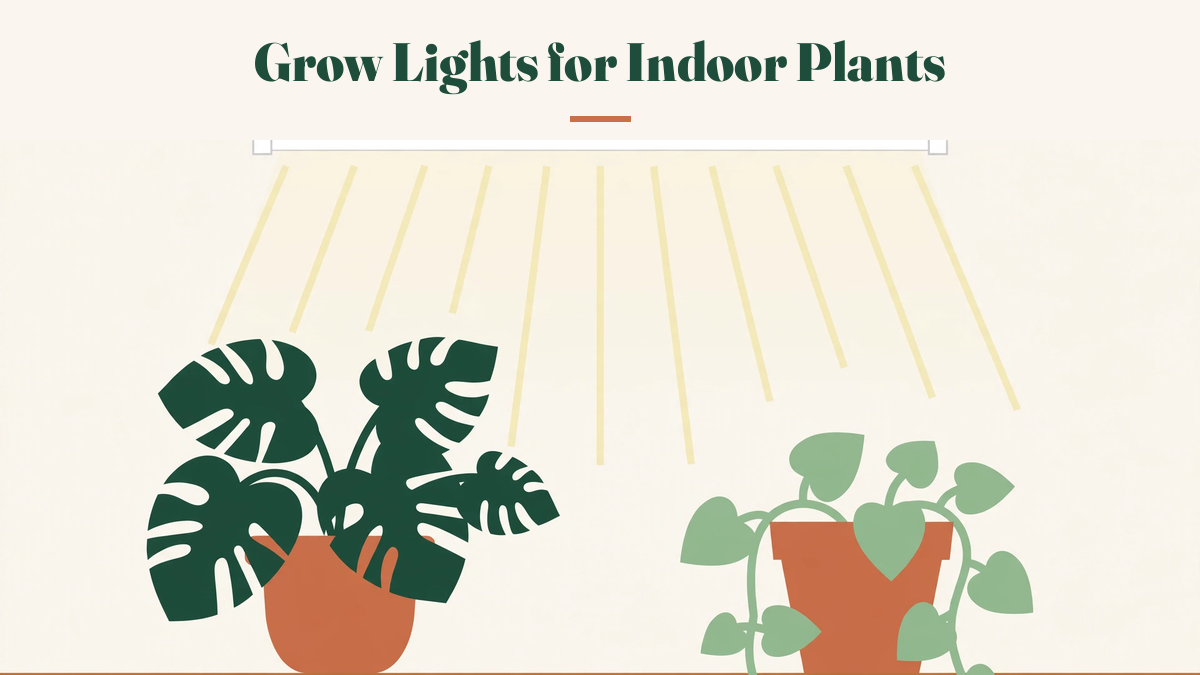
My monstera stopped growing one November. Not dying — just stopped. The newest leaf sat half-unfurled for six weeks, and the plant looked exactly the same every time I glanced at it, which is not how a monstera in its prime behaves. The room it lived in faced north, the days were short, and the nearest window was three metres away. I did what most people do first: I watered it, then I fed it, then I repotted it. None of it helped, because none of it was the problem. The problem was light — there simply wasn't enough of it, and no amount of water or fertiliser was going to fix that.
The grow light I bought that winter changed the plant completely. Within two months it had pushed out two new leaves, each bigger than the last. But I'll be honest: the first light I bought was the wrong one — a purple "blurple" panel I picked because it looked like what a grow light should look like, hung far too high above the plant because I didn't know distance mattered. It took a second purchase and some reading before I got it right.
This guide is the reading I wish I'd done first. It covers whether you actually need a grow light, the four numbers that matter on any listing, the types worth buying, and how to set one up so it works — with the actual numbers from my own shelf setup.
Do you actually need a grow light?
Before spending money, work out whether light is really your problem. Iowa State University Extension calls light "often the most limiting growth factor when growing houseplants" — and it's the factor people check last, because a room that looks bright to human eyes can be far too dim for a plant. Our eyes adjust to low light effortlessly; plants can't.
Here are the signs that light, not water or food, is the limiting factor:
Growth has stalled in the growing season. A plant that grew well in summer and stopped entirely — no new leaves for months while it's still warm and bright outside — is usually short of light. Check this against the season: a plant that stops in winter is resting, and that's normal.
New growth is stretched and pale. Long gaps between leaves, thin stems leaning hard toward the window, new leaves smaller than the old ones — all of these say the plant is reaching for light it can't find. This stretched growth is called etiolation, and it's one of the most reliable low-light symptoms there is.
Variegation is fading. A variegated pothos or philodendron that starts pushing out all-green leaves is usually doing it because it's short of light — green tissue photosynthesises better than white, so the plant drops the variegation to survive.
The plant is far from a window. Light intensity falls off fast with distance. A plant two metres from a window gets a small fraction of the light a plant on the sill gets. Clemson Extension notes that the interior of a well-lit home is often under 100 foot-candles, while outdoor light on a clear day can exceed 10,000 — a hundredfold difference. If your plant sits in the middle of a room, it's living in deep shade by plant standards, however bright the room feels to you.
The shadow test. Hold your hand about 30 cm above the plant at midday. A sharp, well-defined shadow means direct sun. A soft, fuzzy shadow means bright indirect light. Barely any shadow at all means low light — and most houseplants will struggle there without help.
If two or more of those signs apply, a grow light will help. If none of them do, your plant's problem is probably something else — water, pot size, or pests — and a light won't fix it. How much light do indoor plants really need? walks through reading your rooms in more detail, and the best low-light houseplants lists the plants that cope without one.
The four numbers that matter
Grow light listings are full of numbers, and most of them are marketing. Four actually matter, and Iowa State's supplemental-lighting guide explains all of them clearly.
1. PPFD — how much light reaches the leaves. Photosynthetic photon flux density is the amount of plant-usable light landing on a square metre of leaf every second, measured in micromoles per square metre per second (µmol/m²/s). It's the single most useful number on a listing, because it tells you what the plant actually receives — and it changes with distance. The same lamp might deliver 400 µmol/m²/s at 15 cm and 100 at 60 cm. If a listing doesn't publish PPFD at a stated distance, treat its brightness claims with suspicion.
2. Spectrum — what colour the light is. Plants use mainly red and blue wavelengths for photosynthesis. Blue light helps regulate chlorophyll production and keeps stems compact; red light drives photosynthesis and promotes flowering. A good grow light provides both. The simplest way to judge this is the Kelvin rating: lower numbers (around 3000K) are warmer and redder, higher numbers (around 6500K) are cooler and bluer. Iowa State recommends a full-spectrum fixture — sometimes sold as "daylight" — with a Kelvin value in the middle, giving the plant some of both. A plain white LED in the 4000–6500K range does this well. The purple "blurple" panels that only emit red and blue look impressive but make your living room look like a nightclub, and a full-spectrum white LED grows plants just as well while letting you see your plants' real colours.
3. DLI — how much light over the whole day. Daily light integral is the total amount of plant-usable light delivered over 24 hours, measured in moles per square metre per day (mol/m²/day). It's the number that ties intensity and duration together: a dim light left on for longer can deliver the same daily total as a bright light on for fewer hours. Iowa State gives these bands for indoor plants:
| Plant group | DLI needed (mol/m²/day) | Examples |
|---|---|---|
| Low light | 3–6 | Pothos, snake plant, ZZ plant, peace lily |
| Medium light | 6–10 | Monstera, philodendron, ferns, African violet |
| High light | 12–16 | Succulents, herbs, flowering houseplants, seedlings |
The formula is simple: DLI = PPFD × hours on × 0.0036. So a light delivering 120 µmol/m²/s for 13 hours gives a DLI of 5.6 — right in the low-light band, enough for a pothos or a snake plant, but not enough for a succulent. I'll work through my own setup with real numbers below.
4. Distance — the free dial. Light intensity falls off fast with distance. A single bulb follows the inverse-square law — double the distance, quarter the light — while bar and panel LEDs fall off more gently, closer to halving when you double the gap. Either way, a light hung 60 cm above a plant delivers a fraction of what it delivers at 30 cm — the 400-to-100 example above shows a fourfold drop across that range. This is the most common reason a grow light "doesn't work": it's too far away. Distance is also the easiest thing to adjust, and it's free.
The number that doesn't matter: watts. Iowa State is blunt about this: watts are not a reliable indication of light intensity, because they measure the energy the fixture uses, not the light it emits. A 100-watt fixture from one manufacturer can be dimmer than a 40-watt fixture from another. Shop by PPFD at your hanging distance, not by watts. Lumens are better than watts but still measure light as human eyes see it, not as plants use it — a fixture can be high in lumens and low in the wavelengths plants need.
LED vs fluorescent vs everything else
There are four kinds of grow light you'll see for sale. Here's how they compare for a home, not a commercial greenhouse.
| Type | Pros | Cons | Best for |
|---|---|---|---|
| LED (full-spectrum white) | Very energy efficient; low heat; long-lived (25,000+ hours); output doesn't fade; many sizes | Higher upfront cost; cheap ones publish no PPFD data | Almost everything — the default choice in 2026 |
| Fluorescent (T5 tubes) | Cheap; widely available; good for seedlings; cool-running | Tubes lose intensity and need replacing every 1–2 years; must hang close (6–12 in) | Seed trays, propagation shelves, small setups |
| Incandescent | Cheap bulbs; fits any lamp | Very inefficient; produces far more heat than light; plants stretch and go leggy underneath | Nothing — Clemson and Iowa State both advise against them for plants |
| HID (high-intensity discharge) | Extremely bright; used commercially | Very hot; expensive; noisy ballasts; overkill for a living room | Greenhouses and serious indoor growers only |
If you're buying new, buy LED. Washington State's houseplant chapter notes that LED lights are replacing fluorescent bulbs due to their energy efficiency and quality of light, and that matches what I've seen: the LED bar I bought three years ago is still going strong, while the fluorescent tubes I used before it needed replacing every year and gave off noticeably less light by month ten.
Within LEDs, the format matters as much as the technology. Grow bulbs fit a standard lamp and suit a single plant. Clip-on gooseneck lights suit one or two plants on a desk. Bar or tube lights mount under a shelf and cover a row of plants. Panels hang above a large plant or a whole shelf. Buy the format that fits your space — a panel for one pothos is wasted money, and a single bulb won't light a four-foot shelf.
My shelf setup, with the numbers
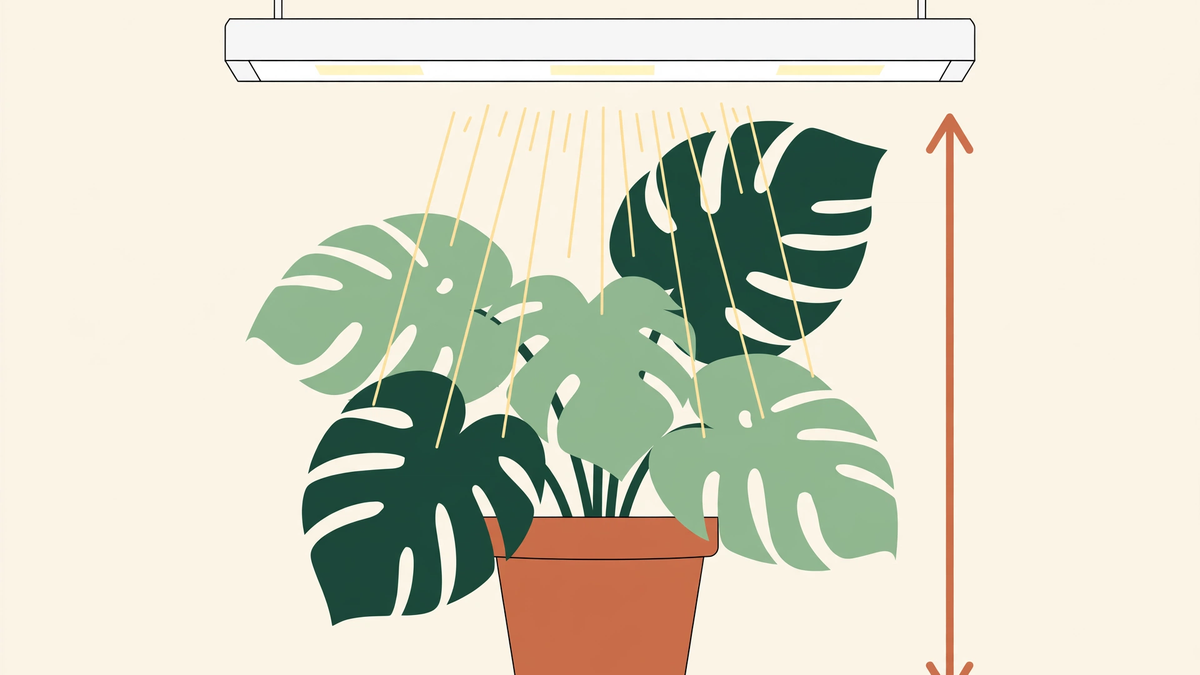
Here's my actual setup, so you can see how the numbers work in practice rather than in theory. I have a three-tier shelf in a north-facing room — no direct sun at any point in the year. The middle shelf holds a monstera, two pothos, and a philodendron. The light is a 60 cm full-spectrum white LED bar, mounted under the shelf above, 45 cm above the tallest leaves. It runs on a timer for 13 hours a day, 7am to 8pm.
The manufacturer's listing gave PPFD figures at two distances: 180 µmol/m²/s at 30 cm, and 110 at 60 cm. At my 45 cm hanging height, the plants get roughly 140 µmol/m²/s — I estimated it between the two published figures, and a phone light-meter app reading (rough, but consistent) agreed within about 10%.
The DLI calculation: 140 PPFD × 13 hours × 0.0036 = 6.6 mol/m²/day. That sits at the bottom of the medium-light band (6–10), which is right for the monstera and more than enough for the pothos. The plants also get whatever natural light the north window provides — not much, but not nothing — so the real total is slightly higher.
The result: the monstera that had stalled for six weeks pushed out a new leaf within a month of the light going up, and has produced a leaf every five to six weeks since. The pothos grow noticeably faster than the ones I keep in a brighter room without a light — which surprised me, until I realised the shelf light gives them more total daily light than a bright window does in winter.
The running cost is small. The bar draws 24 watts. At 13 hours a day, that's about 0.3 kWh per day — roughly 9 kWh a month, which costs less than a cup of coffee in most places. The timer cost less than the bar did, and it's the part I'd never skip: a consistent schedule matters more than a perfect one.
Distance and hours: the setup that works
Distance. Iowa State suggests 12 to 24 inches (30–60 cm) from the foliage for most LED fixtures, and 6 to 12 inches (15–30 cm) for fluorescent tubes. Start at the far end of the range and watch the plant for two weeks. If new growth is still stretched and pale, move the light closer. If leaves bleach or develop pale patches, move it further away. The plant will tell you — faster than any meter will.
Hours. Iowa State's standard recommendation is 12 to 14 hours a day for most indoor plants, with an acceptable range of 10 to 16. Washington State adds that plants should be illuminated for no more than 16 hours — all plants need a dark period to develop properly. I run mine for 13 hours, timed to roughly match daylight, so the plants get a real night. Never run a grow light 24 hours a day: plants need darkness for normal growth processes, and a plant lit around the clock will stress, not thrive.
Timer. Use one. A plug-in timer costs very little and does two jobs: it gives the plant a consistent schedule (which matters more than the exact hours), and it means you can't forget. I set mine to come on at 7am and off at 8pm, and I haven't touched it since.
Position. Hang the light above the plant, not beside it. Light should fall on the top of the foliage, the way sunlight does. A light off to the side makes the plant lean toward it, which defeats the purpose. For a tall plant, angle the light so it covers as much of the foliage as possible — or accept that the lower leaves will get less light and rotate the plant monthly.
Seasonal adjustment. In summer, your plants may not need the light at all — or they may need fewer hours. I turn my shelf light off entirely from June to August, when the north window gives enough light on its own, and switch it back on in September. In winter, the light does the heavy lifting. Indoor plant care in winter covers the full seasonal shift.
What to buy for each situation
One plant in a dim corner. A full-spectrum LED grow bulb in a lamp you already own, or a clip-on gooseneck light. Look for a bulb that publishes PPFD — even a rough figure — and hang or position it 30–45 cm above the plant. This is the cheapest useful setup, and it's enough for a pothos, a snake plant, or a ZZ plant.
A shelf of plants. LED bar or tube lights mounted under the shelf above, one bar per shelf. This is my setup, and it's the best value per plant: one bar covers four to six medium plants. Make sure the bar is long enough to cover the shelf — a bar that covers only half the shelf leaves half the plants in the dark.
A large floor plant. A hanging LED panel or a tall floor lamp with a grow bulb, positioned above the plant. A monstera or fiddle-leaf fig needs a panel with enough spread to cover the whole canopy, not a single spotlight that lights one side.
Seedlings and cuttings. Fluorescent T5 tubes or LED bars hung close — 10–15 cm above the tray — running 14–16 hours a day. Seedlings want more light and more hours than established houseplants, and they want it close. Raise the light as they grow.
A north-facing window. If your plants sit by a north window, they're getting low light year-round. A grow light turns that window into a medium-light spot. The best plants for a north-facing window lists the plants that cope without one — but even those grow faster with a light.
Is it really light? A quick diagnostic
Before you buy anything, it's worth ruling out the other usual suspects — because light deficiency, underwatering, and nutrient deficiency share symptoms, and a grow light won't fix a plant that's actually thirsty.
| Symptom | Most likely light | Most likely water | Most likely nutrients |
|---|---|---|---|
| New leaves smaller than old ones | Yes — the plant can't make enough food | Possible, if soil is dry | Possible, if the plant hasn't been fed in a year |
| Long gaps between leaves, leaning stem | Yes — classic etiolation | No | No |
| Lower leaves yellowing | Possible, in deep shade | Yes — overwatering yellows lower leaves first | Yes — nitrogen deficiency yellows older leaves first |
| Variegation fading to green | Yes — the plant drops variegation to survive | No | No |
| No growth at all in summer | Yes, if light is low | Possible, if roots are damaged | Possible, if soil is exhausted |
| Brown, crispy leaf edges | No — usually humidity or salts | Yes — underwatering crisps edges | Yes — fertiliser burn crisps tips |
The fastest way to narrow it down is to check the easy things first. Push a finger into the soil: if it's wet and the plant is struggling, it's not thirst. Check the light with the shadow test. And ask when the plant last grew well — if it was fine in summer and stopped in winter, light is the prime suspect, because nothing else changed.
Measuring your light without buying anything
You don't need a meter to get a useful reading. Iowa State notes that several smartphone apps can measure light in lux, foot-candles, or PPFD, and that they provide a level of accuracy adequate for the typical home gardener. Download one, hold the phone at leaf height with the sensor facing the light source, and take a reading at midday.
What do the numbers mean? Clemson Extension gives a useful benchmark: about 100 foot-candles for 12 hours a day is necessary simply to maintain plant quality for a year, and at least 200 foot-candles for 12 hours a day is necessary before foliage plants show any benefit from fertilisation. In lux — the unit most phone apps report — 100 foot-candles is roughly 1,000 lux, and 200 is roughly 2,000 lux. (One foot-candle equals 10.76 lux.)
So if your phone reads 500 lux at the plant's leaves at midday, that plant is getting about 50 foot-candles — half of what it needs just to maintain itself, let alone grow. That's a plant that needs a grow light, or a move to a brighter spot. If it reads 3,000 lux, the plant is getting plenty, and the problem is elsewhere. The reading won't be lab-accurate — phone sensors vary, and the app needs to be calibrated for your light source — but it's good enough to tell "plenty" from "nowhere near enough", which is the decision that matters.
One caution: measure at the leaves, not at the window. Light falls off fast with distance, and a reading taken at the glass tells you nothing about what the plant receives two metres into the room. And measure on an ordinary day, not the brightest day of the year — you're trying to find out what the plant gets on average, not at its best.
The mistakes that waste money
Hanging the light too far away. The number one mistake, and the one I made first. A light 1.5 metres above a plant is decorative, not useful. Measure the distance from the light to the top leaves, not from the light to the floor.
Buying on watts. A "1000W" grow light on a marketplace listing usually draws a fraction of that from the wall — the number is a marketing equivalent, not a measurement. Ignore it. Look for PPFD at a stated distance, or at least lumens.
Running the light 24/7. Plants need darkness. A light left on around the clock stresses the plant, wastes electricity, and can disrupt flowering in photoperiod-sensitive plants.
Buying purple "blurple" panels for a living room. They work, but they make your home look strange and they make it hard to see your plants' real colours — which means you spot problems later. Full-spectrum white LEDs grow plants just as well and look like normal light.
Lighting a plant that doesn't need it. A plant in a bright south-facing window doesn't need a grow light, and adding one can scorch it. Check the light first, buy second.
Forgetting the timer. A grow light on an irregular schedule — on when you remember, off when you don't — is worse than no light at all for some plants, because the inconsistent photoperiod confuses their growth cycles. A timer is the cheapest part of the setup and the most important.
Frequently asked questions
Do indoor plants really need a grow light?
Only if your natural light falls short. If a plant has stopped growing, stretches toward the window, or sits more than a couple of metres from any window, a grow light will help. A plant in a bright window usually does not need one.
How far should a grow light be from plants?
For most LED fixtures, 12 to 24 inches (30–60 cm) above the foliage. Fluorescent tubes sit closer, 6 to 12 inches. The right distance depends on the fixture's output — check the manufacturer's guidance and watch the plant.
How many hours a day should a grow light be on?
12 to 14 hours a day for most foliage houseplants, on a timer. Iowa State Extension advises a range of 10 to 16 hours, and never 24 — plants need a dark period.
Are LED grow lights better than fluorescent?
For most homes, yes. LEDs use less energy, produce less heat, last longer, and their output does not fade the way fluorescent tubes do. Fluorescents still work well for seedlings and small setups.
What does PPFD mean on a grow light listing?
Photosynthetic photon flux density — the amount of plant-usable light actually reaching the leaves, measured in micromoles per square metre per second. It is the most useful number on the box, because it changes with hanging distance.
If you remember one thing… shop by PPFD at your hanging distance, hang the light close enough to matter, and put it on a timer — the rest is detail.