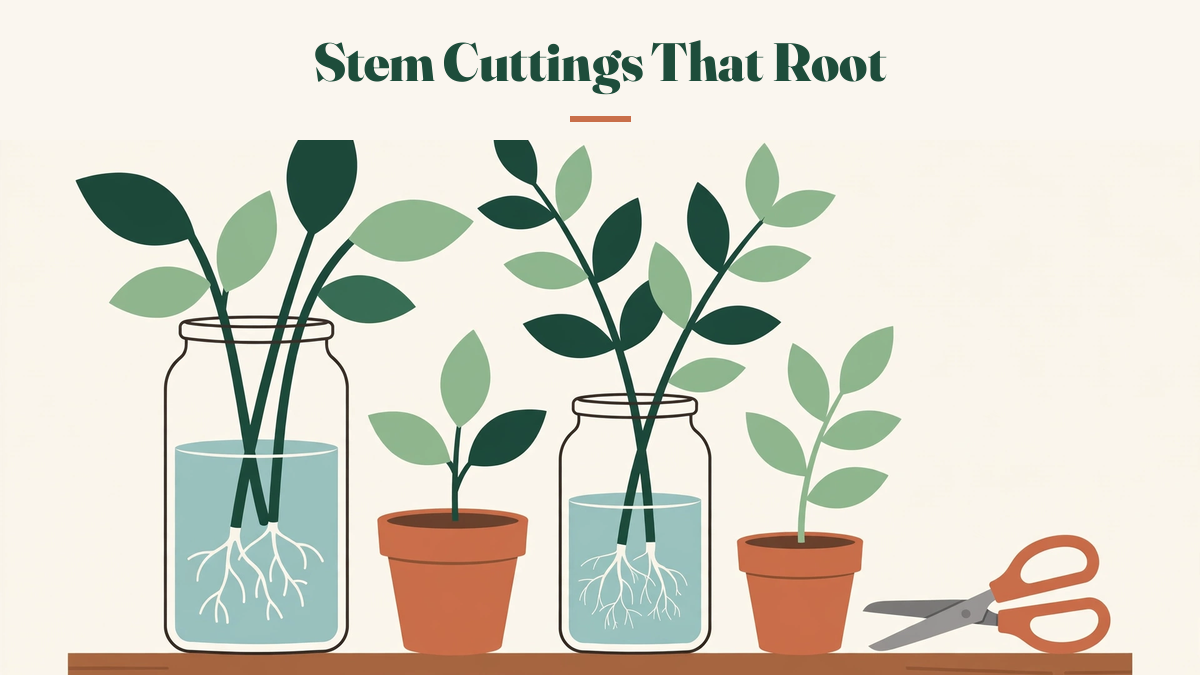
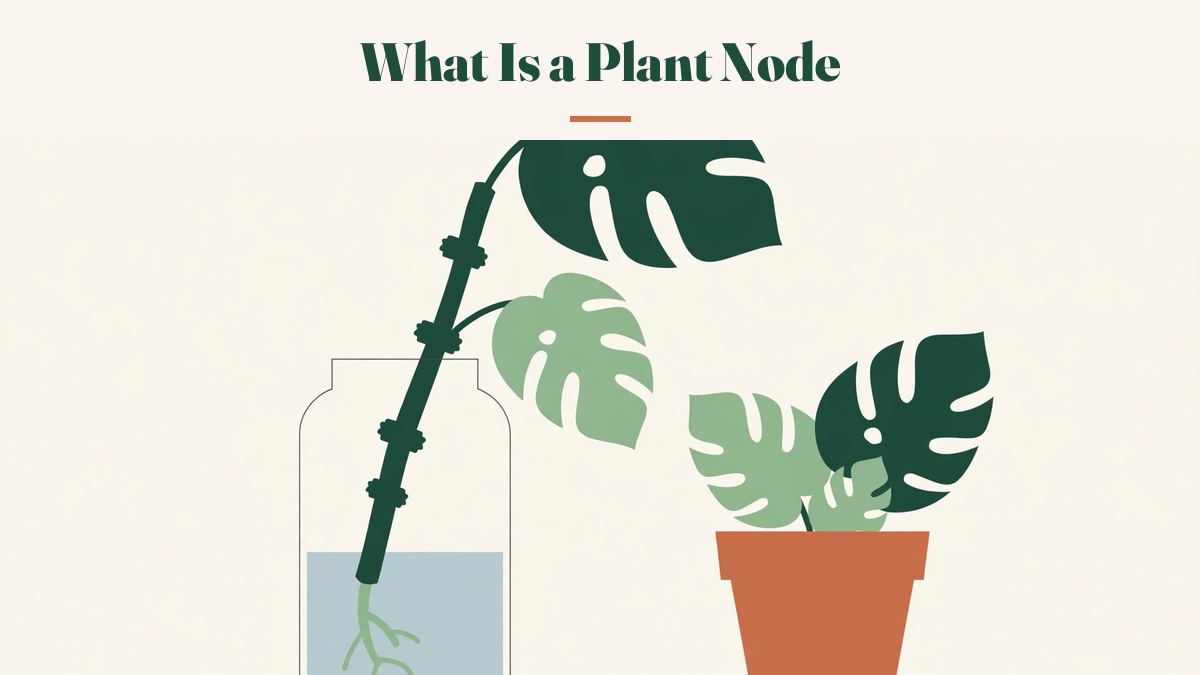
Two jars sat side by side on my windowsill for six weeks. In one, a pothos cutting had rooted within days — white roots curling out of the stem, a new leaf already unfurling. In the other, a monstera leaf I'd snipped off with great optimism sat in the same water, in the same light, and did absolutely nothing. It stayed green for a month, which kept my hopes up, then yellowed and finally went soft and collapsed. The difference between the two jars was about two centimetres of stem — and one small bump on it.
That bump was a node, and it is the single most important thing to understand about propagation. Every cutting that has ever rooted did so because it had a node. Every cutting that sat in water for weeks doing nothing failed because it didn't. Once you can spot a node, most propagation failures stop being mysteries.
What a node actually is
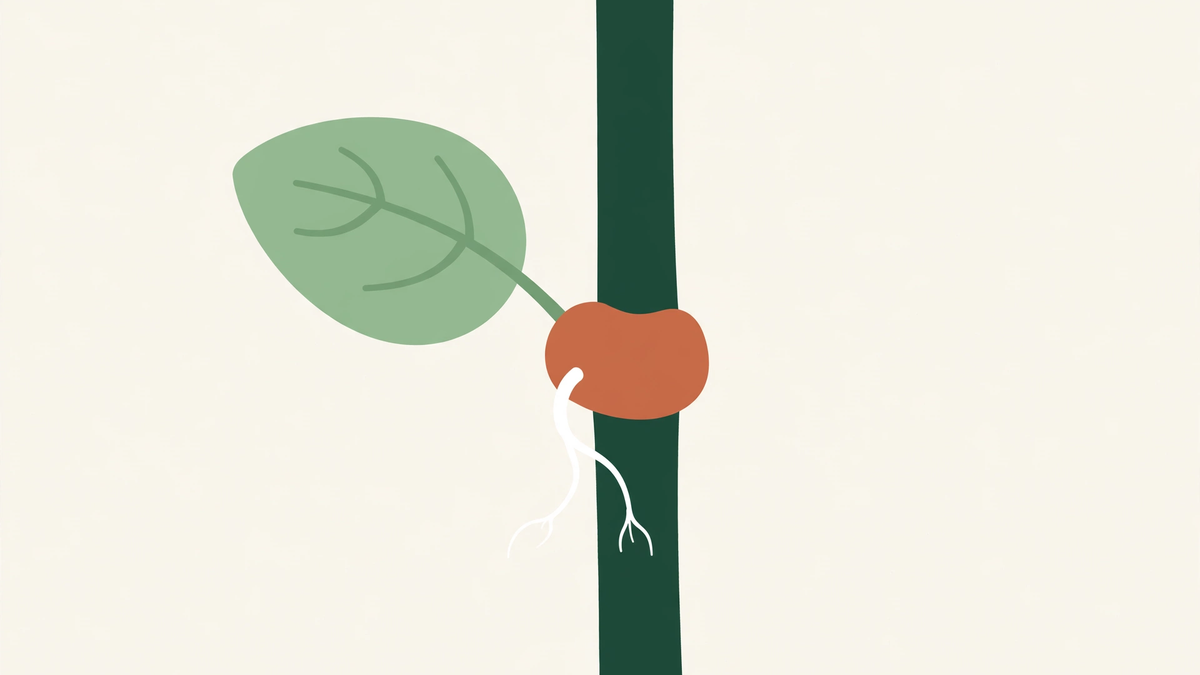
A node is the point on a stem where a leaf grows out. Run your finger along a pothos vine and you'll feel them: slight swellings or bumps at regular intervals, each with a leaf (or a leaf scar, where a leaf used to be) attached. Between two nodes is the internode — the smooth stretch of bare stem. Illinois Extension describes a node as the place where the leaf emerges, sometimes a bumpy or raised area, and that's exactly what it feels like.
What makes the node special is what's inside it. Nodes contain meristematic tissue — clusters of undifferentiated cells that can become roots, shoots, or leaves depending on what the plant needs. The University of Georgia's extension service describes this as the magic of vegetative propagation: meristematic areas occur at the shoot and root tips and along the stem where leaves grow, and they're why a stem cutting can grow roots to support a new plant. A node also holds a dormant axillary bud, tucked into the angle between the leaf and the stem, waiting to become a new branch.
The internode, by contrast, has none of this. It's just stem — structural tissue, plumbing for water and sugars, nothing that can start a new plant. That's why my monstera leaf failed: I'd cut a leaf with a length of petiole (the leaf stalk) and no stem at all. There was no node, no meristem, no bud. The leaf could stay alive for a while, but it could never grow roots, because the machinery for growing roots wasn't there.
Finding the node on the plants you actually own
Nodes look different on different plants, and the variation is what trips people up.
| Plant | What the node looks like |
|---|---|
| Pothos / philodendron | A clear bump where each leaf joins, often with a small brown nub — a root primordium — on the opposite side |
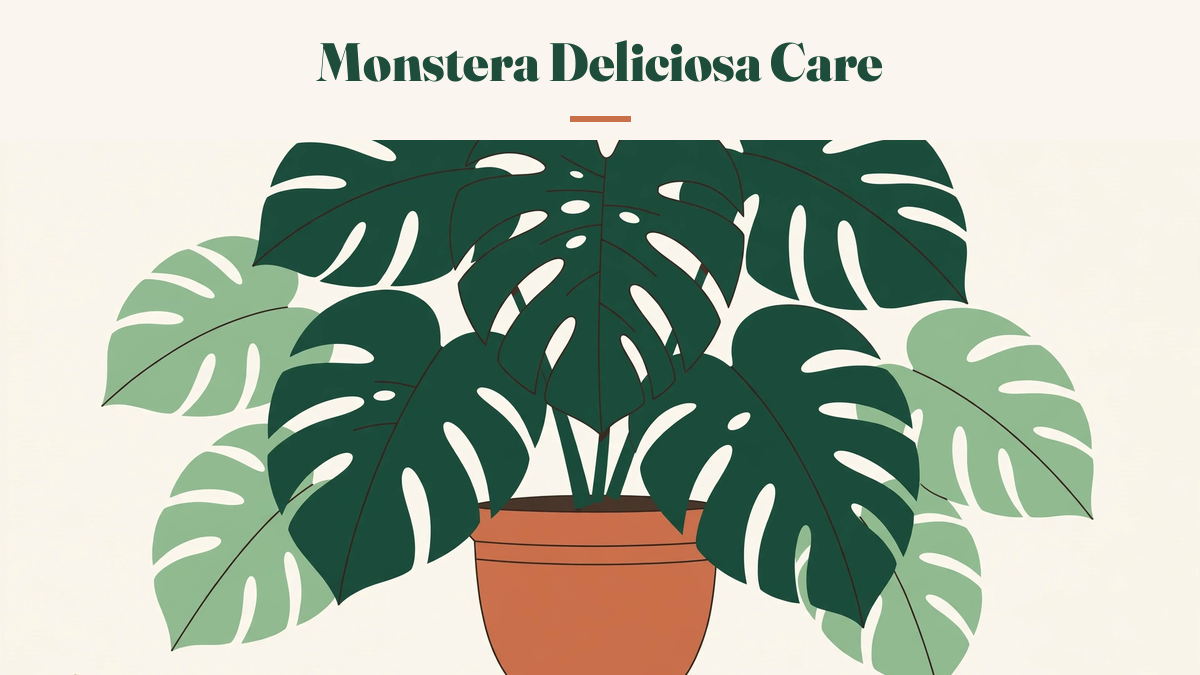
| Monstera | A thicker ring around the stem at each leaf joint, often with a thick aerial root emerging from it |
| Tradescantia | A slightly swollen joint, usually a different colour from the rest of the stem |
| Hoya | A small bump at each leaf pair; the stem between nodes is thin and wiry |
| Fiddle-leaf fig / rubber plant | A ring or scar on the woody stem where a leaf attaches; on older stems, a faint horizontal line |
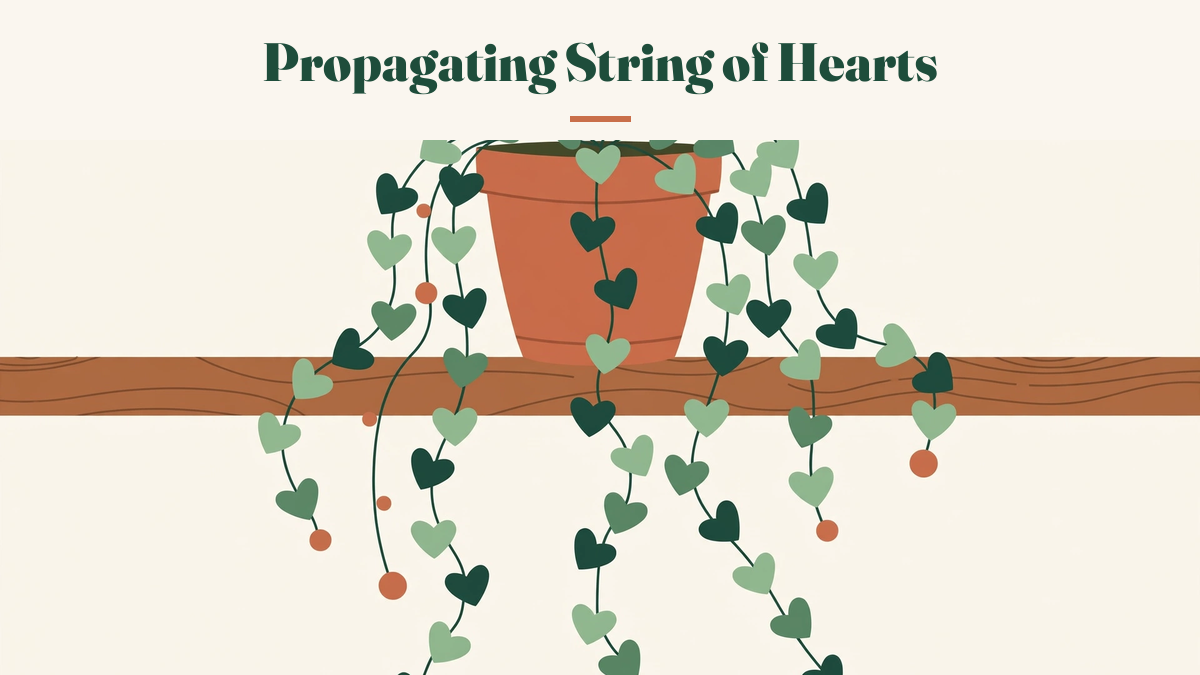
| String of hearts | A tiny joint between each pair of heart-shaped leaves, sometimes with a small tuber attached |
| Snake plant / ZZ plant | No visible stem nodes — these grow from rhizomes underground, so stem cuttings work differently |
The aerial root trick is the most useful shortcut in propagation: if you can see an aerial root, the node is right where it emerges. On a monstera or a philodendron, the thick brown roots dangling from the stem mark the nodes more clearly than anything else.
One more thing worth knowing: nodes stay viable even after the leaf has fallen off. The scar where a leaf used to attach still marks a node, and the dormant bud beside it is usually still alive. A bare stretch of monstera stem with three old leaf scars has three usable nodes, and each one can become a cutting.
Why a node-less cutting can't root
It's worth being precise about this, because the usual advice — "make sure your cutting has a node" — rarely explains why. A stem cutting needs two things to become a plant: roots to take up water, and a growing tip to make new leaves. Both come from the node. The meristem tissue at the node produces adventitious roots, and the axillary bud produces the new shoot. Without a node, the cutting has neither, and no amount of rooting hormone, warm water, or patience changes that — hormone can stimulate existing meristem tissue, but it can't create it where there is none.
This is also why leaf cuttings work for some plants and not others. A leaf cutting has no node, so it can only work if the plant is one of the minority that can form adventitious buds from leaf tissue — African violets, succulents, begonias, snake plants. NC State Extension's propagation guide puts it plainly: leaf cuttings of most plants will not generate a new plant, because they don't include an axillary bud, and they usually produce only a few roots or just decay.
Cutting below the node: the practical bit
Knowing what a node is matters most at the moment you pick up the scissors. Here's the method:
Choose a healthy stem with at least two nodes visible. Iowa State Extension recommends cuttings 3–6 inches long with at least two nodes — one to go below the surface and root from, and one above to grow from.
Cut just below a node, about half a centimetre under it. Cut at a 45-degree angle, which gives more surface area for rooting and marks which end is the bottom. Iowa State warns that stem segments will not root upside down, and a flat cut on both ends makes it embarrassingly easy to plant a cutting the wrong way up.
Remove the lower leaves. Any leaf that would sit below the water or soil line should come off — submerged leaves rot, and the rot spreads to the stem. Leave two or three leaves at the top. If the remaining leaves are very large, cut them in half to reduce water loss while the cutting has no roots.
Place the node in contact with the medium. In water, the node should be submerged. In soil, it should be buried about 2 cm deep. A node sitting in dry air above the soil line won't root — it needs moisture to trigger the meristem into action.
The stem cuttings guide covers the full process in detail, and the pothos water propagation guide is the best first project for practising node-spotting — pothos nodes are large, obvious, and forgiving.
The mistakes that all come back to the node
Almost every failed cutting I've investigated — mine and other people's — traces back to one of three node errors:
Cutting above the node. You snip the stem a centimetre above the leaf joint, leaving the node on the mother plant. The cutting is a piece of internode with a leaf. It will never root. Always check: is there a bump on the cutting, below the lowest leaf?
Cutting through the node. A cut that slices through the middle of the node damages the meristem tissue. Cut below it, not through it.
Burying the node too deep — or not at all. In soil, a node buried 5 cm down in wet mix is more likely to rot than to root. About 2 cm is right. And a node left above the waterline in a jar won't root either — it needs moisture to trigger the meristem.
Once you see the node as the unit of propagation — one node, one potential plant — the whole subject gets simpler. A long pothos vine isn't one cutting; it's six or eight, one per node. And a leaf in a jar, however beautiful, is a leaf in a jar.
Frequently asked questions
What is a node on a plant?
A node is the point on a stem where a leaf attaches — usually a slight bump or swelling. It holds the meristem tissue and dormant buds that can grow into roots or new shoots.
Can a cutting root without a node?
For most houseplants, no. A stem cutting without a node has no meristem tissue to grow roots from. A few plants, like African violets and succulents, are exceptions that can form new growth from leaf tissue alone.
Where do I cut a stem for propagation?
Just below a node, about half a centimetre under it. The node goes into water or soil, and the roots grow from it. Cut at an angle so you can tell which end is the bottom.
How many nodes should a cutting have?
At least one node below the soil or water line, and ideally two nodes in total — one to root from and one above the surface to grow from. Iowa State Extension recommends cuttings 3–6 inches long with at least two nodes.
Is an aerial root the same as a node?
No, but they're neighbours. An aerial root grows out of or just below a node. If you see an aerial root, the node is right there — it's the most reliable way to find one on a monstera or philodendron.
If you remember one thing… the node is the whole cutting — find the bump, cut just below it, and put it in water or soil; everything else is just patience.