The first bottle of fertilizer I ever bought had "20-20-20" printed on the front in big friendly numbers, and I had no idea what any of it meant. I assumed bigger numbers meant better fertilizer, bought the strongest one on the shelf, and then used it at full strength on everything I owned. The plants survived — mostly — but I spent a season wondering why my peace lily's leaf tips had gone brown and why my pothos was growing long and leggy instead of full.
The three numbers on a fertilizer label are the most useful piece of information on the whole bottle, and they're not complicated once someone explains them. They tell you exactly what you're feeding your plant, in what proportions, and they let you choose a fertilizer the way you'd choose a recipe — matched to what the plant actually needs. This guide explains what each number means, how to read a label in thirty seconds, and which ratios suit which plants.
What the three numbers actually mean
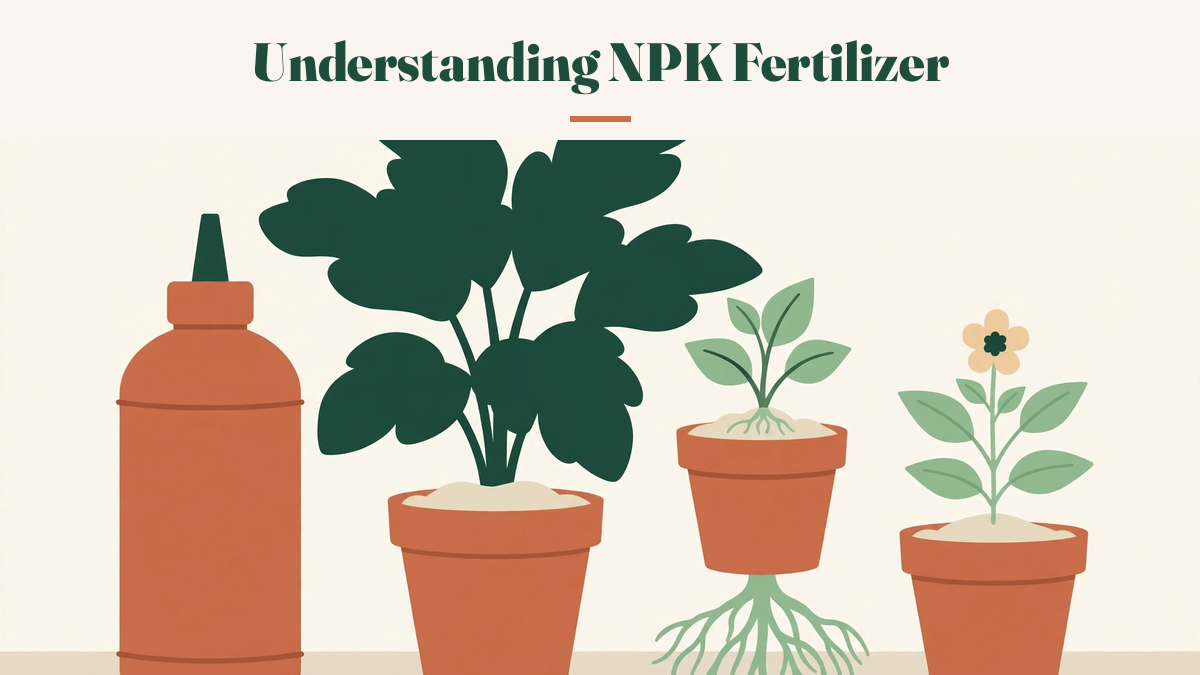
NPK stands for three chemical elements: N for nitrogen, P for phosphorus, and K for potassium (K comes from kalium, the Latin name — blame the periodic table, not me). These are the three nutrients plants need in the largest quantities, and the numbers on the label show each one's percentage by weight, always in that same order: N-P-K.
So a bottle labelled 10-10-10 contains 10% nitrogen, 10% phosphorus, and 10% potassium by weight. A bottle labelled 20-20-20 contains twice as much of each — it's more concentrated, not better. The remaining percentage is filler, water, or other ingredients. The ratio between the three numbers is what matters most; the absolute numbers mostly tell you how concentrated the product is, and therefore how much to dilute it.
Each nutrient does a different job:
Nitrogen (N) — leaves and stems. Nitrogen drives leafy, green growth. It's the nutrient behind lush foliage, and it's the one most houseplants run short of first, because plants use it up fastest. A plant short on nitrogen grows slowly and its older leaves turn pale yellow-green, starting from the bottom. Too much nitrogen, though, and you get soft, leggy growth — long stems, big floppy leaves, and a plant that's more attractive to pests.
Phosphorus (P) — roots and blooms. Phosphorus supports root development and flowering. It's the nutrient that matters most when a plant is establishing itself after repotting, and it's the one flowering plants need most. A plant short on phosphorus may grow slowly and fail to bloom; its leaves can take on a dark, almost purplish tinge. Most foliage houseplants need relatively little phosphorus, which is why balanced fertilizers work fine for them.
Potassium (K) — overall strength. Potassium is the general-health nutrient. It helps the plant regulate water, resist disease, and cope with stress — heat, cold, drought. A plant short on potassium often shows brown, crispy edges on older leaves, which is easy to mistake for a watering problem. Potassium doesn't produce dramatic visible growth the way nitrogen does, but a plant without enough of it is fragile in every direction.
A useful shorthand I learned early on, and still use: N is for leaves, P is for flowers and roots, K is for health. It's a simplification, but it's the right simplification for choosing a fertilizer off a shelf.
Reading a label in thirty seconds
Let's decode a typical bottle together. Imagine a liquid houseplant fertilizer with this on the label:
All-Purpose Houseplant Food — 10-10-10 Dilute 5 ml per litre of water. Feed every 2 weeks in spring and summer.
Here's what that tells you. The 10-10-10 means equal parts nitrogen, phosphorus, and potassium — a balanced fertilizer, suitable for most foliage plants. The dilution instruction (5 ml per litre) is the dose: ignore it and you're guessing. And the timing — every two weeks in the growing season — tells you this is a regular-feeding product, not a one-off tonic.
Now compare a second bottle:
Bloom Booster — 15-30-15 Dilute 5 ml per litre. Feed every 2 weeks while flowering.
The middle number is double the others. That's a high-phosphorus fertilizer, designed to encourage flowering. It would be a good choice for a peace lily, an African violet, or a hoya in bud — and a poor choice as an everyday feed for a monstera, which wants leaves, not flowers, and would be getting phosphorus it doesn't need while missing out on the nitrogen it does.
That thirty-second comparison is the whole skill. You don't need to memorise ratios; you just need to look at which number is biggest and ask whether that matches what your plant is doing. Leaves? You want nitrogen equal to or higher than the rest. Flowers? You want the middle number higher. A plant that's struggling in general? Balanced is safest.
One more label detail worth knowing: some fertilizers list additional nutrients — calcium, magnesium, iron, and trace elements. These are genuinely useful, especially iron and magnesium, which prevent yellowing in some plants. A fertilizer that lists micronutrients is usually a better product than one that lists only NPK. But if the label doesn't list them, it doesn't mean the fertilizer is bad — it means those nutrients aren't in it, and your plant will need to get them from its soil.
Which ratio for which plant
Here is the table I keep taped inside my potting cupboard. It covers the ratios you'll actually see on shelves, and what each one is for. If you only buy one fertilizer, buy a balanced one — it covers most plants, most of the time.
| Ratio | Type | Best for | Notes |
|---|---|---|---|
| 10-10-10 or 20-20-20 | Balanced | Most foliage houseplants: pothos, monstera, philodendron, ferns | The safe default. 20-20-20 is the same ratio, twice as concentrated — halve the dose. |
| 15-30-15 or 10-30-20 | High phosphorus | Flowering plants: peace lily, African violet, hoya, orchid | Use while the plant is budding or blooming, not year-round. |
| 5-5-5 or 3-3-3 | Gentle / organic | Seedlings, cuttings, sensitive plants, frequent feeding | Low concentration means a lower burn risk; good for weekly weak feeds. |
| 2-7-7 or similar | Cactus / succulent | Cacti, succulents, snake plants, ZZ plants | Low nitrogen, higher phosphorus and potassium — matches slow growth. |
| 24-8-16 | High nitrogen | Heavy leafy growers in active growth: large monstera, fiddle-leaf fig | Pushes foliage fast. Easy to overdo — use at half strength. |
| 0-0-0 (seaweed / tonic) | No NPK | A supplement, not a feed | Seaweed extract adds trace elements and growth hormones but almost no NPK. Use alongside a real fertilizer, not instead of one. |
Two things in that table trip people up. The first is the cactus ratio: cacti and succulents need very little nitrogen because they grow slowly, and feeding them a high-nitrogen fertilizer produces weak, stretched growth that flops. The second is seaweed extract, which is sold next to the fertilizers and looks like one, but contains almost no NPK. It's a useful supplement — I use it myself — but it won't feed a hungry plant on its own.
How much is too much: the dilution maths
The most common fertilizer mistake isn't choosing the wrong ratio — it's using too much. Fertilizer burn happens when salts build up in the soil faster than the plant can use them, and the symptoms (brown leaf tips, crispy edges, wilting despite wet soil) look exactly like other problems, so people often respond by feeding more.
The maths is simpler than it looks. A 20-20-20 fertilizer at the label dose of 5 ml per litre gives you the same amount of nutrients as a 10-10-10 at 10 ml per litre. The concentration on the label and the dose on the label work together — you can't judge one without the other.
My rule, learned the expensive way: use half the label dose, twice as often, rather than the full dose on schedule. Most manufacturers' doses assume ideal conditions — bright light, active growth, a plant in a large pot. The average indoor plant in average light uses nutrients more slowly, and the unused salts accumulate. Half-strength every two weeks gives the plant a steady supply without the build-up. In winter, I stop feeding entirely — a resting plant doesn't need food, and fertilising a dormant plant is one of the fastest ways to burn its roots.
A worked example, so the numbers are concrete. Say you have a 20-20-20 liquid fertilizer, the label says 5 ml per litre, and you water a medium monstera with about a litre of water. At full strength, that plant gets roughly 1 gram of each nutrient per feed. At half strength (2.5 ml per litre), it gets half a gram — and over a six-month growing season at fortnightly feeds, that's about 6 grams of each nutrient total, which is plenty for a plant in a pot. If you fed at full strength every week instead, you'd be delivering four times that amount, and most of it would sit in the soil as salt.
If you've already overfed — brown tips appeared after a feed, or there's a white crust on the soil surface — flush the soil with plain water until it runs freely from the drainage holes, then skip feeding for a month. The white crust is crystallised fertilizer salt, and it's the clearest sign that the soil has had too much. Brown leaf tips: causes from water to fertilizer covers how to tell fertilizer damage from water damage.
Signs you're getting it wrong
Too much fertilizer: brown, crispy leaf tips and edges (especially after a feed); a white crust on the soil or pot rim; leaves wilting even though the soil is moist; sudden leaf drop after feeding. The fix is to flush the soil, stop feeding for at least a month, and resume at half strength.
Too little fertilizer: slow or no growth during the growing season despite good light and water; older leaves turning pale yellow-green; new leaves smaller than old ones; a plant that hasn't been repotted or fed in over a year. The fix is to start a regular half-strength feeding routine — but check light first, because a plant in dim light won't grow no matter how much you feed it.
Wrong ratio: a flowering plant that grows lush leaves but never blooms (too much nitrogen); a foliage plant that stays small and dark while its pot-mates thrive (not enough nitrogen). The fix is to match the ratio to what the plant is doing, using the table above.
One honest caveat: fertilizer is the least likely cause of most houseplant problems. Light, water, and pot size cause far more trouble than nutrition. If your plant is struggling, check those first, and reach for the fertilizer bottle last. A plant in poor light won't be saved by feeding — it'll just get salt-burned on top of everything else.
The numbers that aren't NPK
The three big numbers aren't the whole story. Most decent fertilizers also list secondary nutrients and micronutrients in smaller print — calcium, magnesium, iron, manganese, zinc. Plants need these in tiny amounts, but a plant missing one of them shows it: iron deficiency turns new leaves yellow while the veins stay green, and magnesium deficiency yellows older leaves from the edges inward. If your fertilizer lists micronutrients, that's a point in its favour; if it doesn't, your plant gets them from its soil, which is one more reason fresh potting mix matters.
You'll also see organic fertilizers with very low numbers — fish emulsion is often around 5-1-1, worm castings lower still. Those low numbers don't mean they're weak; they mean the nutrients release slowly as soil microbes break the material down, so the plant gets a steady trickle instead of a single dose. The trade-off is smell (fish emulsion is exactly as fragrant as it sounds) and slower results. I use a liquid synthetic fertilizer for everyday feeding and add worm castings to my potting mix when I repot — the castings feed the soil, the liquid feeds the plant, and between them most of my plants never show a deficiency at all.
My feeding routine, season by season
For context, here is what I actually do across the year. It's deliberately simple — one balanced liquid fertilizer, half strength, on a seasonal schedule.
- Spring (March–May): Start feeding when new growth appears, usually mid-March. Half-strength balanced feed every two weeks. This is the season feeding matters most — the plant is waking up and growing fast.
- Summer (June–August): Continue every two weeks. Flowering plants get a high-phosphorus feed once a month instead of one balanced feed. Skip feeding in a heatwave — a stressed plant doesn't need salts on top of heat.
- Autumn (September–October): Taper off. One feed in early September, one in early October, then stop. Growth is slowing, and leftover fertilizer in the soil over winter is a burn risk.
- Winter (November–February): No feeding at all. The plants are resting. The only exception is a plant under a grow light that's actively growing — and even then, monthly at half strength is plenty.
That routine covers nearly every plant I own. The exceptions are cacti and succulents (a cactus-ratio feed, monthly, spring and summer only) and anything I repotted recently — fresh potting mix usually contains enough nutrients for the first couple of months, so I wait before feeding a newly repotted plant. For the broader picture on feeding — types of fertilizer, organic options, and timing — see how to feed indoor plants. And if you're mixing your own soil, the ingredients matter as much as the feed: perlite, peat, and bark explains what each one does, and the best soil mix for indoor plants gives you the recipes.
Frequently asked questions
What does NPK mean on fertilizer?
NPK stands for nitrogen (N), phosphorus (P), and potassium (K) — the three nutrients plants need in the largest amounts. The numbers on the label show each nutrient's percentage by weight, always in that order.
What is the best NPK ratio for houseplants?
A balanced ratio like 10-10-10 or 20-20-20 suits most foliage houseplants. Flowering plants benefit from a higher middle number, such as 15-30-15, which supports blooms.
Is a higher NPK number better?
Not necessarily. Higher numbers mean a more concentrated fertilizer, not a better one. A 20-20-20 is simply twice as strong as a 10-10-10 — you use half as much. What matters is the ratio between the numbers and the dose.
Can I use the same fertilizer for all my houseplants?
For most foliage plants, yes — one balanced liquid fertilizer covers nearly everything. Flowering plants and cacti are the main exceptions, and they do better with a ratio matched to their needs.
How do I know if my plant needs fertilizer?
Slow growth in the growing season, pale new leaves, and a plant that has been in the same soil for over a year are the usual signs. But check light and water first — those cause the same symptoms.
If you remember one thing… N is for leaves, P is for flowers and roots, K is for health — and half the label dose, twice as often, beats full strength every time.